USAID DEC
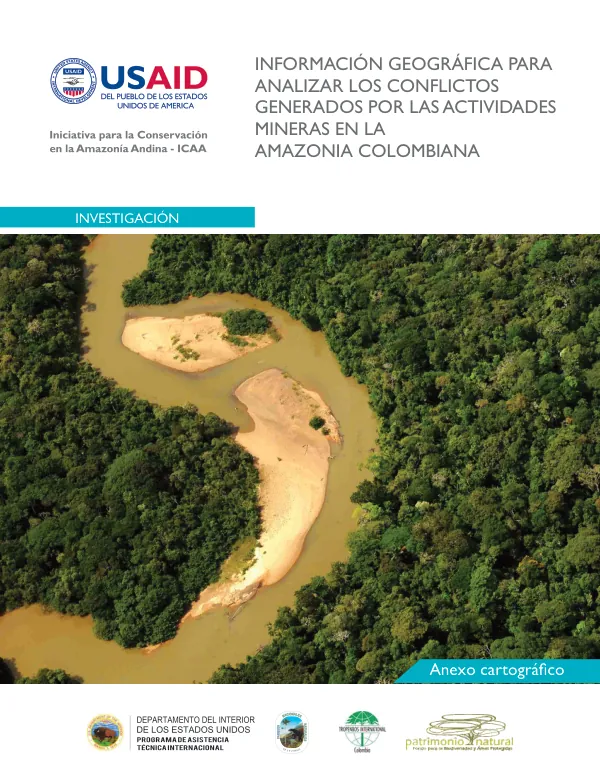
Information Geographical for Analyzing Conflicts Generated by Mining Activities in the Colombian Amazon
Sign inUSAID DEC
Information Geographical for Analyzing Conflicts Generated by Mining Activities in the Colombian Amazon
The Amazonian region of Colombia is characterized by diverse dynamics and transformation drivers, including extractive activities.
2016 · 48 pages
Sign in to readA free account is required to download.
Abstract
To address the challenges posed by these activities, it is essential to implement technological resources, geo-referenced information, and local knowledge to construct informed agreements among institutions, sectors, and communities regarding the management of mining and its environmental, social, economic, and cultural impacts. The compilation of geographic information on mining activities integrated into a permit information system would consolidate dimensions previously understood in isolation and fragmentation into a global vision of the territory and its interrelations with other elements present in the region, such as the environmental, economic, social, and cultural aspects. This information would contribute to answering questions about the location, condition, trends, variations, patterns, and scenarios of extraction and exploration mining, which would help to better understand the current territorial situation and model future scenarios to predict situations and plan necessary activities to manage them. The Amazonian region is characterized by a high level of biodiversity, with a wide range of ecosystems, including tropical rainforests, savannas, and wetlands. The region is also home to a diverse array of indigenous communities, each with their own distinct culture, language, and traditional practices. The mining activities in the region have significant impacts on the environment, including deforestation, water pollution, and soil degradation, as well as social impacts, such as displacement of communities and loss of traditional livelihoods. The Colombian government has established various institutions and programs to regulate and monitor mining activities in the Amazonian region. These include the Ministry of Environment and Sustainable Development, the National Mining Agency, and the Colombian Geological and Mining Institute. However, despite these efforts, the region continues to face significant challenges related to mining, including the lack of effective regulation, inadequate monitoring, and insufficient community engagement. The compilation of geographic information on mining activities in the Amazonian region is a critical step towards addressing these challenges. This information would provide a comprehensive understanding of the current situation, including the location, extent, and type of mining activities, as well as their environmental, social, and economic impacts. This information would be essential for developing effective policies and strategies to manage mining activities in the region, including the establishment of protected areas, the implementation of sustainable mining practices, and the promotion of community engagement and participation. The compilation of geographic information on mining activities in the Amazonian region would also contribute to the development of a more comprehensive understanding of the region's natural resources, including the location and extent of mineral deposits, the distribution of water resources, and the presence of biodiversity hotspots. This information would be essential for developing effective conservation and management strategies for the region's natural resources, including the establishment of protected areas, the implementation of sustainable land-use practices, and the promotion of eco-tourism. The compilation of geographic information on mining activities in the Amazonian region would also provide a valuable tool for community engagement and participation. This information would enable communities to better understand the impacts of mining activities on their environment, their livelihoods, and their cultural heritage. This information would also enable communities to participate more effectively in decision-making processes related to mining activities, including the establishment of protected areas, the implementation of sustainable mining practices, and the promotion of community engagement and participation.