USAID DEC
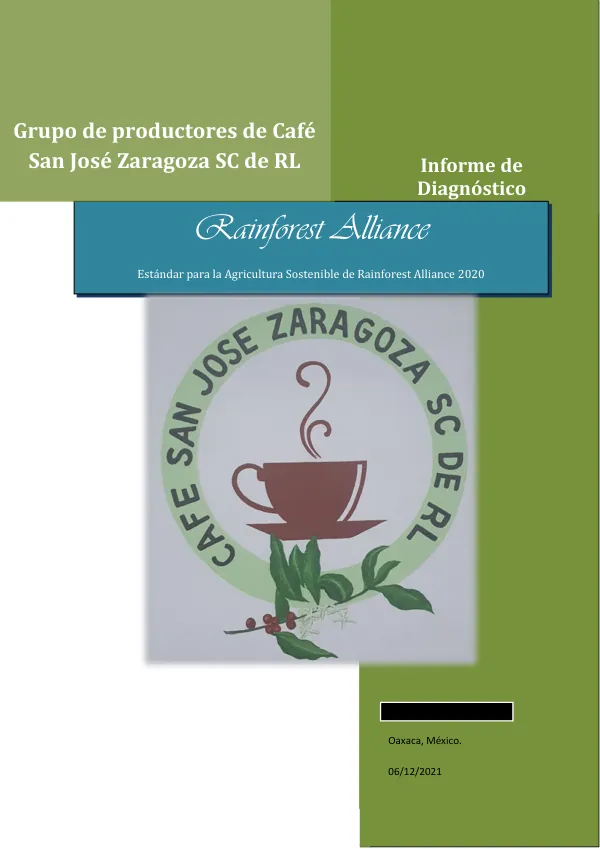
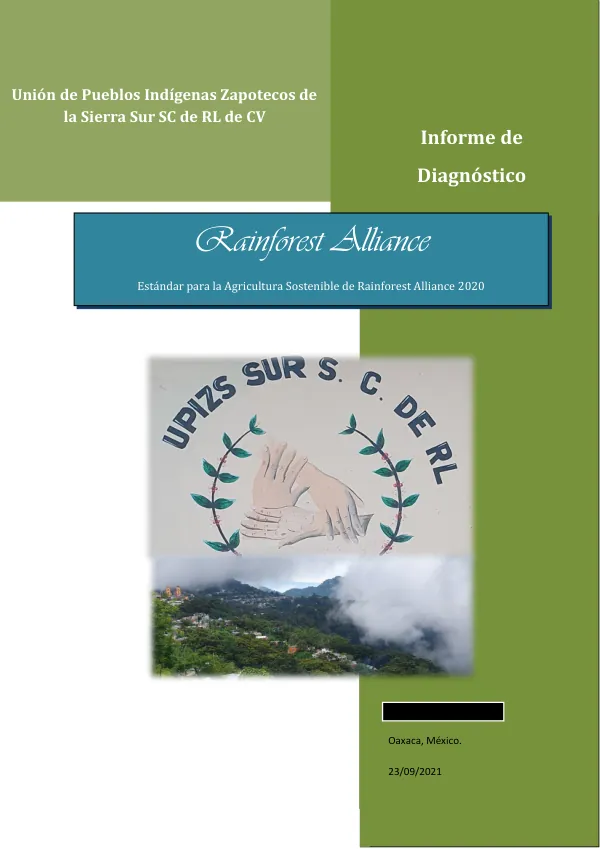
Informe de Diagnóstico: Evaluación del Estándar para la Agricultura Sostenible de Rainforest Alliance 2020
Sign inRAINFOREST ALLIANCE
Informe de Diagnóstico: Evaluación del Estándar para la Agricultura Sostenible de Rainforest Alliance 2020
The Unión de Pueblos Indígenas Zapotecos de la Sierra Sur S.C.
2021 · 117 pages
Sign in to readA free account is required to download.
Abstract
de R.L. de C.V. is a group of 203 producers dedicated to the production of organic coffee in the municipality of San Agustín Loxicha and surrounding communities. The group has a total of approximately 602.5 hectares of land and is interested in developing sustainable practices in their production and management systems. As part of their development initiatives and with the support of allied institutions, the group has decided to evaluate their practices under the "Rainforest Alliance Sustainable Agriculture Standard 2020." This evaluation focuses on assessing a sample of the group's farms and administration, based on the fundamental requirements of the standard, to determine areas of opportunity that need to be addressed to meet the standard. The evaluation is based on the "Requisitos para Fincas, versión 1.1" of the Rainforest Alliance Sustainable Agriculture Standard 2020, which includes the fundamental requirements for farms. The evaluation is focused on the requirements for small farms, as the producers in the group do not predominantly use external labor, but rather rely on family labor, and the average farm size is approximately 3 hectares. The evaluation results show that the administrator of the group demonstrated compliance with 19% of the applicable requirements, while the average performance of the group's farms evaluated in the sample (15 farms) showed compliance with 50% of the applicable requirements. The results indicate that the group has areas of opportunity that need to be addressed to meet the standard. The evaluation results are presented in a summary table, which shows the number of applicable requirements, the number of requirements in compliance, and the percentage of performance obtained in relation to the fundamental requirements. The table shows that the administrator of the group achieved compliance with 15 out of 77 applicable requirements, while the average performance of the group's farms evaluated in the sample achieved compliance with 20 out of 40 applicable requirements. The evaluation results also show that the group's farms have areas of opportunity in various chapters of the standard, including management, traceability, income and shared responsibility, agriculture, social, and environmental aspects. The evaluation results are presented in a detailed manner, including the compliance obtained by each farm in the sample and the administrator, as well as an analysis of the main areas of opportunity for the group. The evaluation results indicate that the group needs to address areas of opportunity in various chapters of the standard to meet the requirements. The group should consider that this diagnosis was developed in a sample of farms that integrate the group, and the observations made may apply to the other farms, without guaranteeing that the requirements identified as in compliance in this sample generalize to the other farms. The evaluation results are presented in a detailed manner, including the compliance obtained by each farm in the sample and the administrator, as well as an analysis of the main areas of opportunity for the group. The evaluation results are intended to provide the group with a clear understanding of their current situation and the areas that need to be addressed to meet the standard. The evaluation results are also intended to provide the group with a roadmap for improvement, including recommendations for addressing areas of opportunity and improving their performance in various chapters of the standard. The evaluation results are a valuable tool for the group to improve their sustainable practices and meet the requirements of the Rainforest Alliance Sustainable Agriculture Standard 2020. The evaluation results show that the group has made progress in various areas, including the implementation of sustainable practices and the improvement of their performance in various chapters of the standard. However, the evaluation results also indicate that the group needs to address areas of opportunity in various chapters of the standard to meet the requirements. The evaluation results are a valuable tool for the group to improve their sustainable practices and meet the requirements of the Rainforest Alliance Sustainable Agriculture Standard 2020. The group should consider the evaluation results as a starting point for improvement and work towards addressing the areas of opportunity identified in the evaluation.