USAID DEC
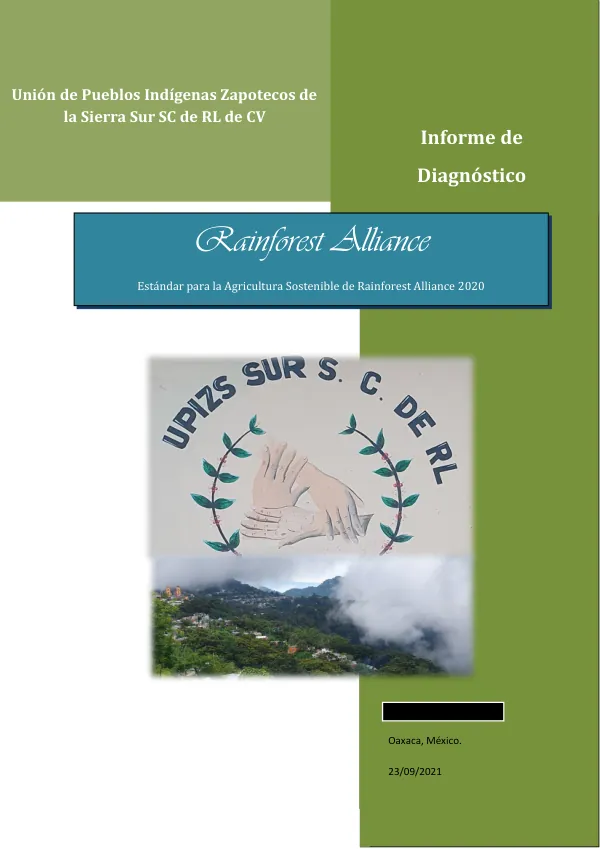
Informe de Diagnóstico: Evaluación del Estándar para la Agricultura Sostenible de Rainforest Alliance 2020
Sign inRAINFOREST ALLIANCE
Informe de Diagnóstico: Evaluación del Estándar para la Agricultura Sostenible de Rainforest Alliance 2020
The agricultural development initiative in Oaxaca, México, focuses on sustainable practices in coffee production.
2021 · 124 pages
Sign in to readA free account is required to download.
Abstract
The Grupo de Productores Café de San José Zaragoza SC de RL, a group of 545 members, aims to develop sustainable practices in their production systems. The group has its offices in the municipality of San José Zaragoza and covers an area of approximately 1,356 hectares. The group has decided to evaluate their practices under the "Estándar para la Agricultura Sostenible de Rainforest Alliance" to identify areas for improvement. This evaluation focuses on a sample of 23 farms from different communities and the group's administration, based on the fundamental requirements of the standard. The report includes the description of the sample inspected, the findings of the evaluation, and the results obtained. The standard for sustainable agriculture, developed by Rainforest Alliance, consists of six chapters: Gerencia, Trazabilidad, Ingreso y Responsabilidad Compartida, Agricultura, Social, and Medio Ambiente. The evaluation is based on the Requisitos para Fincas, versión 1.1, and the Requisitos fundamentales. The group's evaluation focused on the fundamental requirements for small farms, as the producers primarily use family labor or the "guiza" system (mutual support), and the average farm size is 2.5 hectares. The evaluation results show that the group's administrator demonstrated compliance with 17% of the applicable requirements, while the average performance of the inspected farms was 42%. The administrator's performance is illustrated in a graph, showing the compliance rate for each chapter of the standard. The graph also shows the minimum and maximum performance rates for the farms in each chapter. The evaluation results are presented in detail in the section on results, including an analysis of the main areas of opportunity for the group. The section on findings describes all the evaluated requirements in detail, and the section on conclusions summarizes the most significant findings from the evaluation exercise. The group's performance is compared to the minimum and maximum performance rates for each chapter, highlighting areas for improvement. The evaluation results indicate that the group's administrator and the inspected farms have areas for improvement in several chapters of the standard, including Gerencia, Trazabilidad, Ingreso y Responsabilidad Compartida, Agricultura, Social, and Medio Ambiente. The group's performance is below the minimum performance rate in some chapters, indicating a need for improvement. The evaluation results provide a basis for the group to identify areas for improvement and develop strategies to address these areas. The group can use the evaluation results to improve their performance and achieve compliance with the Rainforest Alliance standard. The evaluation results also provide a basis for the group to develop a plan to improve their performance and achieve certification under the Rainforest Alliance standard. The group's performance in each chapter of the standard is as follows: * Gerencia: 5% * Trazabilidad: 19% * Ingreso y Responsabilidad Compartida: 33% * Agricultura: 17% * Social: 50% * Medio Ambiente: 0% The group's performance is below the minimum performance rate in some chapters, indicating a need for improvement. The group can use the evaluation results to develop strategies to improve their performance and achieve compliance with the Rainforest Alliance standard.