USAID
Initial Environmental Examination (IEE) for USAID Projects
Environmental Screening and Assessment Requirements for USAID Projects The project design process for USAID projects involves an environmental screening to identify the level of risk or impact to the environment.
2016 · 3 pages
Sign in to readA free account is required to download.
Abstract
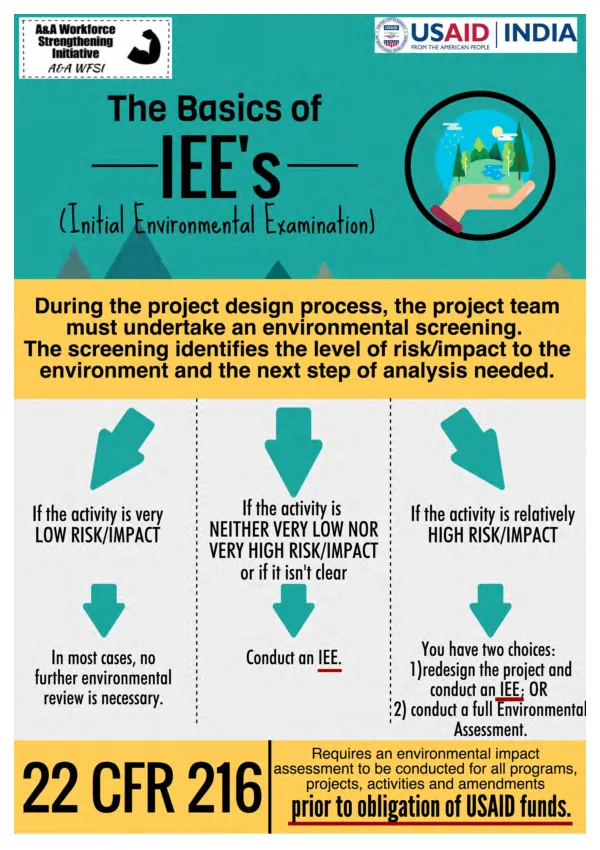
This screening determines the next step of analysis needed, which may include an Initial Environmental Examination (IEE) or a full Environmental Assessment (EA). If an activity is deemed to have very low risk or impact, no further environmental analysis is required. However, if the activity falls into a category of neither very low nor very high risk or impact, or if the level of risk or impact is unclear, an IEE must be conducted. An IEE is a review of the reasonably foreseeable effects of a proposed action on the environment, providing a factual basis for a Threshold Decision as to whether an EA is required. Activities with high risk or impact require a more detailed analysis. The project team has two options: redesign the project and conduct an IEE, or conduct a full EA. The 22 CFR 216 regulation requires an environmental impact assessment to be conducted for all programs, projects, activities, and amendments prior to the obligation of USAID funds. The IEE makes a recommendation as to whether a proposed activity will have a significant impact on the environment. It provides the factual basis for a Threshold Decision as to whether a more detailed EA is required. An IEE is conducted as part of the project design process and is included in the Project Authorization Document (PAD). It must be completed before funds are obligated. The project design team must complete the IEE template, which is available on the USAID/India pages and the GEMS website. The process involves developing an IEE, which is reviewed and coordinated by the Mission Environmental Officer (MEO) and the Bureau Environmental Officer (BEO). The BEO approves the IEE. Key terms include Categorical Exclusion, which refers to activities that do not affect the environment, such as training or providing technical assistance. In contrast, activities that involve the use of pesticides, creation of Genetically Modified Organisms (GMOs), or introduction of non-native species do not qualify for a categorical exclusion. The Environmental Assessment (EA) is a detailed study of the reasonably foreseeable significant effects, both beneficial and adverse, of a proposed action on the environment of a foreign country or countries. The EA is similar to an Environmental Impact Statement but is tailored for foreign countries. For further information, USAID's Global Environmental Management Support website and the environmental compliance resources on USAID/India pages provide additional guidance and resources.