GOVERNMENT OF INDONESIA
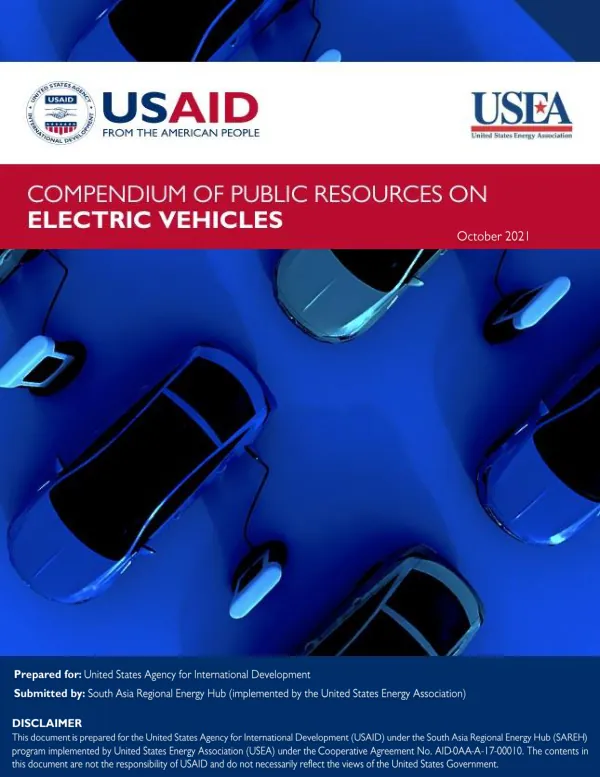
Compendium of Public Resources on Electric Vehicles
The South Asia Regional Energy Hub (SAREH) has developed a compendium of public resources on electric vehicles (EVs) in India.
2021 · 15 pages
Sign in to readA free account is required to download.
Abstract
The document aims to provide a structured collection of publicly available information on EVs, serving as a quick reference for countries in the early stages of mobility transition. The compendium is designed to help governments, donors, and consultants identify low-regret quick-start initiatives, design pilot or full-scale projects, and formulate policies and schemes. The compendium is organized into four categories: policies, incentives, infrastructure, and research and development. The policies section covers national and sub-national government plans, regulations, and schemes to promote, accelerate, and incentivize the adoption of EVs and EV charging infrastructure in India. The section includes documents such as the National Electric Mobility Mission Plan (NEMMP) 2020, the Scheme for Faster Adoption and Manufacturing of EV (FAME) in India - Phase II, and the Amendments in Model Building Bye-Laws for Electric Vehicle Charging Infrastructure. The incentives section provides information on the various incentives offered by the government to promote the adoption of EVs, including tax exemptions, subsidies, and low-interest loans. The infrastructure section covers the development of charging infrastructure, including the guidelines for public charging stations and the requirements for private charging infrastructure. The research and development section includes information on the research and development activities being undertaken in the EV sector, including the development of new technologies and the testing of EVs. The compendium also includes information on the electric vehicle market in India, including the number of EVs sold, the types of EVs being sold, and the growth rate of the EV market. The document highlights the potential of e-mobility to reduce emissions, eliminate vehicular pollution, and decrease dependence on imported oil in South Asian countries. Several international developmental, research, and not-for-profit organizations have offered research, technical, and analytical assistance to support the development of domestic e-mobility programs and policies in India. The assistance has covered data collection, information synthesis, generating insights, developing model documents, and training toolkits. The compendium is a valuable resource for countries in the early stages of mobility transition, providing a structured collection of publicly available information on EVs in India. The document can be used by governments, donors, and consultants to identify low-regret quick-start initiatives, design pilot or full-scale projects, and formulate policies and schemes. The electric vehicle market for passenger cars is largest in Asia Pacific followed by Europe and North America. With the Electric Vehicle (EV) industry picking up pace in South Asia, various countries in the region are showing active interest in learning from the regional experience. India is at the epicenter of e-mobility activities in the region with the National Electric Mobility Mission Plan (NEMMP) in place for achieving national energy security. The government has extended the Faster Adoption and Manufacturing of Hybrid and Electric vehicle (FAME) II policy by 2 years. This policy, coupled with recent changes in incentive structure and introduction of EV policies by select states, will enable faster penetration of EVs, especially two-wheelers and three-wheelers. The compendium provides a comprehensive overview of the electric vehicle market in India, including the policies, incentives, infrastructure, and research and development activities being undertaken in the sector.