USAID
Initiating the National Strategy for Global Development Act of 2009
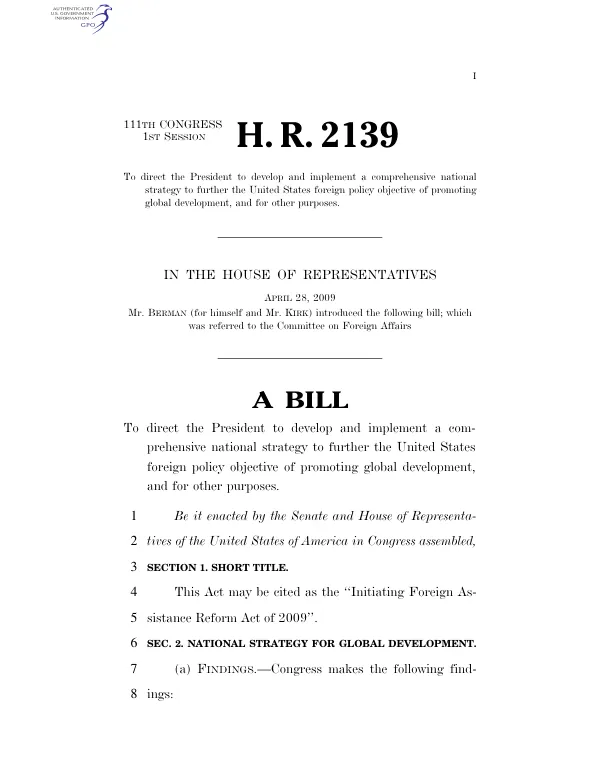
The bill, known as the Initiating Foreign Assistance Reform Act of 2009, aims to direct the President to develop and implement a comprehensive national strategy to promote global development.
2009 · 20 pages
Sign in to readA free account is required to download.
Abstract
The strategy is intended to further the United States' foreign policy objective of reducing poverty and contributing to broad-based economic growth in developing countries. The bill makes several key findings, including that poverty, lack of opportunity, and environmental degradation are significant contributors to socioeconomic and political instability, as well as to the exacerbation of disease pandemics and other global health threats. The bill also notes that the 2002 and 2006 National Security Strategies of the United States emphasize the importance of assisting the world's poor citizens and integrating them into the global economy. The bill requires the President to develop and implement a comprehensive national strategy to further the United States' foreign policy objective of reducing poverty and contributing to broad-based economic growth in developing countries. The strategy, known as the National Strategy for Global Development, should support United States engagement with developing countries to reduce poverty and contribute to broad-based economic growth. The strategy should include several key elements, such as defining the role of United States Government departments and agencies in carrying out global development policies and programs, establishing development objectives for global development policies and programs, and reviewing and improving coordination among United States Government departments and agencies carrying out global development policies and programs. The bill also requires the President to consult with the Committee on Foreign Affairs of the House of Representatives and the Committee on Foreign Relations of the Senate, nongovernmental stakeholders, international financial institutions, other international organizations involved in humanitarian assistance and development efforts, and developing countries in developing and implementing the strategy. The bill requires the President to transmit the strategy to Congress within 90 days of the date of enactment and to publish the strategy on the White House website. The bill also requires the President to develop and implement a rigorous system to monitor and evaluate the effectiveness and efficiency of United States foreign assistance. The National Strategy for Global Development should be flexible and responsive to changing objectives, approaches, and needs of developing countries and changing United States foreign policy and national security interests. The strategy should also include budget requirements to carry out the strategy. The bill aims to improve the effectiveness and efficiency of United States foreign assistance by requiring the President to develop and implement a comprehensive national strategy to promote global development. The strategy should support United States engagement with developing countries to reduce poverty and contribute to broad-based economic growth.