USAID DEC
Innovative Financing Mechanisms for Improved Access to Primary Healthcare in Nigeria
Sign inMINISTRY OF HEALTH
Innovative Financing Mechanisms for Improved Access to Primary Healthcare in Nigeria
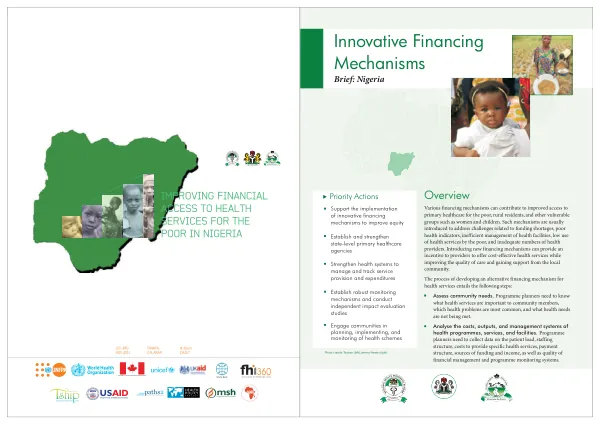
The Nigerian government has introduced various financing mechanisms to improve access to primary healthcare for the poor, rural residents, and other vulnerable groups.
2013 · 4 pages
Sign in to readA free account is required to download.
Abstract
These mechanisms aim to address challenges related to funding shortages, poor health indicators, inefficient management of health facilities, low use of health services by the poor, and inadequate numbers of health providers. One such mechanism is the health equity fund, which is a demand-side financial mechanism established to improve access to priority public health services for the poor. The fund addresses challenges of limited access to and use of health services by providing specific health services for free or at a subsidised cost to the poor and vulnerable groups. The agency holding the funds sets criteria for beneficiaries, decides on services to be covered, establishes a screening process, and sets up a system or contracts with a local agency to reimburse service providers. The equity fund run by the Ambursa community in Kebbi State is supported entirely by private donations. The fund has raised 5 million Naira (US$31,700), which has been used to cover operational costs for maternal and child health service deliveries, pay for services for 1,200 poor women and children, set up a revolving fund for drugs and consumables, and purchase an ambulance for obstetric emergencies. The fund's success owes much to its management committee, which maintains transparency and accountability and ensures adherence to eligibility criteria. Another financing mechanism is the pooled funding approach, which involves pooling funds from different sources to support health services. The Abiye Equity Fund in Ondo State is supported by World Bank and state and local government funding. The Abiye Fund introduced free health services for pregnant women and children under age 5, emphasised community mobilisation, and equipped health facilities in every ward of the local government area. Between 2009 and 2011, deliveries in health facilities had tripled, and the number of pregnant women making antenatal visits had increased nearly five-fold. The basket funding approach is another mechanism used in Nigeria. Zamfara State set up a basket fund to support immunisation and selected maternal health services. By pooling funds from the state's 14 local government areas, the state government, and development partners, the state mobilised 1.5 million Naira (US$9,684) and set up a state bank account with these funds in 2009. Each local government area has its own account in the same bank, and funds are disbursed directly to beneficiaries by finance officers. Exemption schemes are also used to provide free or subsidised healthcare services to specific groups such as the poor and vulnerable populations. Governments often set criteria to provide free or subsidised healthcare services to specific groups, but these policies need financial support from the government as well as private sector charitable groups. Programme planners need to set clear criteria for individuals or groups to be exempted and/or designate specific health services to be covered, and set up a system for screening eligible people. In Nigeria, Jigawa State has implemented an exemption scheme to provide free healthcare services to pregnant women and children under age 5. The scheme has improved access to healthcare services for the target population, but programme managers have faced challenges in managing the increased demand for services and ensuring that the services are reaching people in need. The Nigerian government has also established a national health insurance scheme to provide health insurance coverage to the poor and vulnerable populations. The scheme aims to improve access to healthcare services and reduce the financial burden on households. However, the scheme has faced challenges in terms of funding, management, and implementation. Overall, the financing mechanisms introduced in Nigeria aim to improve access to primary healthcare for the poor, rural residents, and other vulnerable groups. These mechanisms have shown promise in improving health outcomes and reducing health inequities, but they require careful planning, management, and implementation to ensure their sustainability and effectiveness.