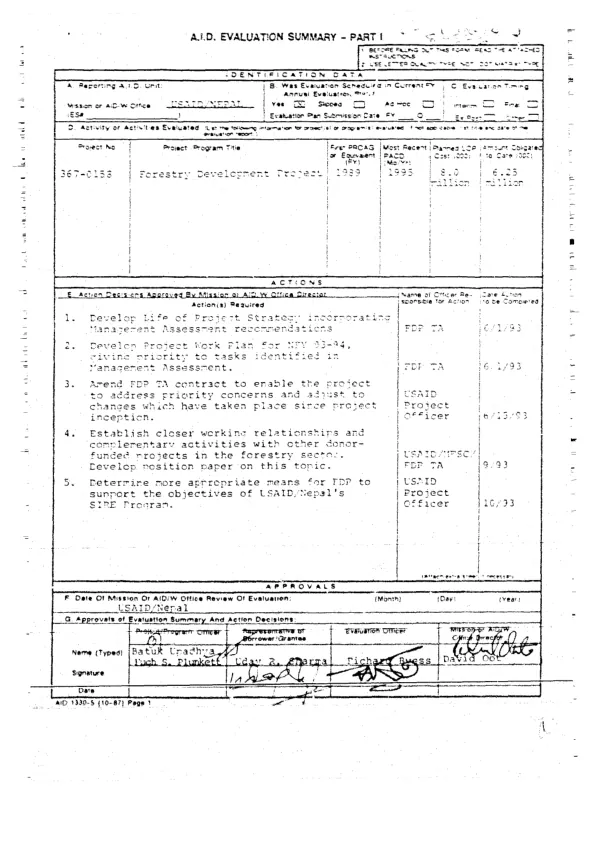
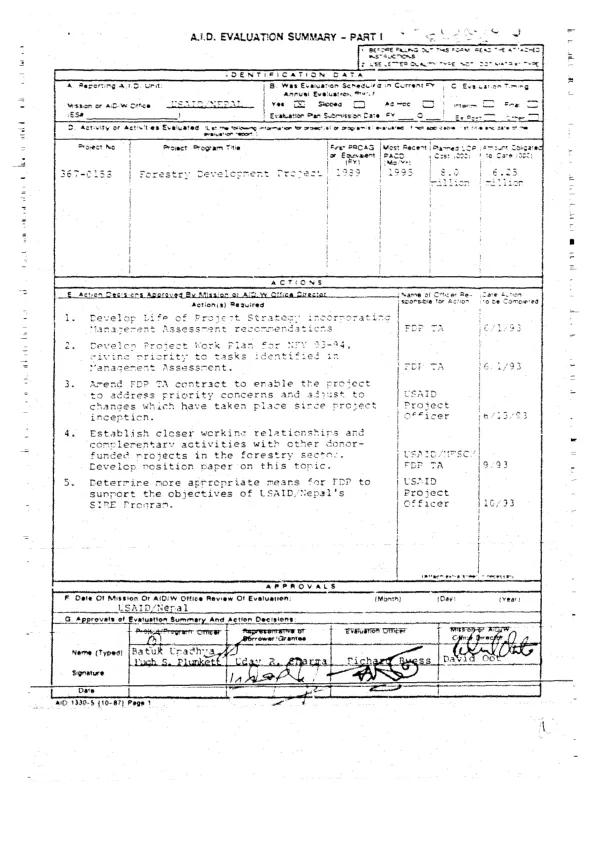
USAID. MISSION TO NEPAL
Institute of forestry
Project, follow-on to 3670132, to upgrade the capacity of the Institute of Forestry (IOF) of Tribhuvan University in Nepal to train foresters and natural resource managers at the B.S.
1987
Sign in to readA free account is required to download.
Abstract
and Certificate levels, with special attention to community forestry management. The project will improve IOF"s administration, curricula, faculty competence, policies, applied research, and facilities. IOF will upgrade its B.Sc. program (now offered at the new Pokhara campus) and its Certificate programs at both Pokhara and Hetauda campuses. Curricula for the programs will be improved, most notably through the inclusion of more practical field and laboratory work. Much of the former will take place at a forest to be designated for IOF use by the Nepalese government; also, community forestry projects will be undertaken with village groups. The project will provide short-term pedagogical training for all IOF faculty and short- and long-term training for selected faculty (including up to 15 M.S"s and 5 Ph.D."s) in a wide range of subjects. Field and laboratory manuals and other teaching materials will be developed and a faculty evaluation system initiated. Faculty will be provided grants for applied research activities, including extension and demonstration projects and case studies in natural resource management. The project will provide TA in research policy and priorities, research training, a special program for research by junior faculty, and support to the IOF Journal. IOF will upgrade its administrative structure by, inter alia, establishing a Campus Operations Office and preparing maintenance and development plans and an administrative manual. Over the life of the project, IOF will graduate 200 B.Sc."s and 1,000 Certificate holders. The enrollment of women and of students from remote areas will be increased; the project will provide scholarships to women students and book and equipment grants to all students. The project will also fund 2 long-term advisors, in management (7 years) and forestry (4 years); 16 PCV"s; a visiting scholar program; commodities (e.g., vehicles, computers, laboratory equipment, library materials); new classroom and laboratories at Pokhara and additional facilities in Hetauda; and small campus improvements. Parallel support is being provided by the World Bank.
Related documents