USAID. MISSION TO NEPAL
Institute of Forestry project
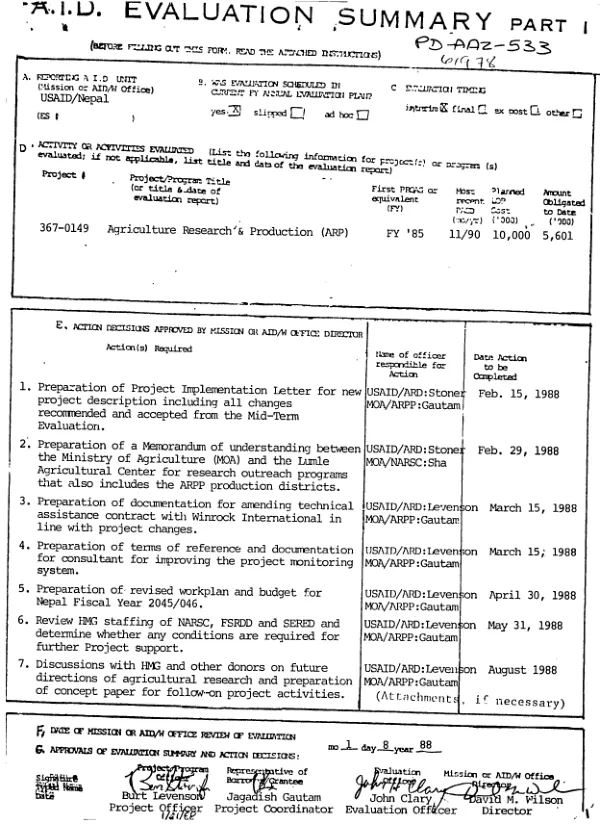
Summarizes mid-term evaluation (XD-ABD-923-A) of a project to strengthen the Institute of Forestry (IOF) of Nepal"s Tribhuvan University.
1992
Sign in to readA free account is required to download.
Abstract
The evaluation covered the period FY87-1/92. The project has made considerable progress despite social, political, economic, and bureaucratic constraints and should attain most objectives by the 1995 PACD. The original project design is sound, although some shifts in emphasis need to be made. Further long-term training should be delayed until the IOF has determined that it can be resumed without negatively affecting the academic program. Ph.D. training should be discontinued and funds shifted toward Master"s degree training in general forestry and social forestry. TA in proposal preparation and research methods has substantially improved IOF abilities. The project has also improved the IOF"s relations with granting agencies and increased the availability of research funds. However, the emphasis on research, particularly in social forestry, has caused resentment among some faculty who have not directly benefitted. At this stage, there should be a shift in emphasis from research toward curriculum development, a better integration of research activities with student training, and a better relationship with other Nepali research institutions to make sure that IOF research is consistent with national priorities. Although the project has increased faculty awareness of the role of social science in forestry, poor academic discipline and lack of a functional academic calendar have constrained project efforts to improve the quality of education at IOF. The project has initiated efforts to recruit more women and students from remote areas and has begun to develop admission and stipend award procedures that enhance opportunities for these groups. However, the IOF is producing more graduates than the job market can absorb and females have significantly more difficulty in finding employment than do males. Moreover, appropriate on-campus housing for women does not exist. Despite some progress, institutional sustainability problems still abound. Divisiveness among the faculty has slowed implementation of training, previous IOF administrations have not made consistent efforts to maintain or create links with other agencies, and the IOF has no effective system for the sustainable management of its operations. IOF currently lacks the capacity to fulfill project expectations that it could profitably manage its forests. Procurement is basically on schedule, despite delays in approval procedures and in customs. However, the IOF campuses are in need of considerably more renovation than can be provided under the project budget.