MCSP
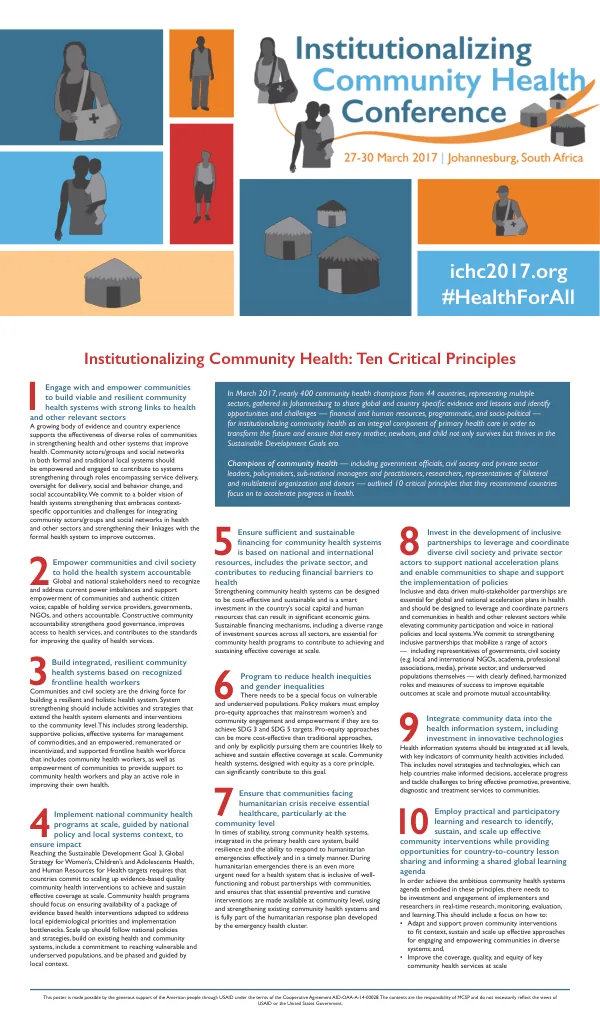
Institutionalizing Community Health: Ten Critical Principles
Community health systems play a crucial role in strengthening health and other systems that improve health outcomes.
2017 · 1 pages
Sign in to readA free account is required to download.
Abstract
A growing body of evidence and country experience supports the effectiveness of diverse roles of communities in strengthening health and other systems. Community actors and social networks in both formal and traditional local systems should be empowered and engaged to contribute to systems strengthening through roles encompassing service delivery, oversight for delivery, social and behavior change, and social accountability. Empowering communities and civil society to hold the health system accountable is essential for good governance, improved access to health services, and high-quality health services. Global and national stakeholders need to recognize and address current power imbalances and support the empowerment of communities and authentic citizen voice, capable of holding service providers, governments, NGOs, and others accountable. Constructive community accountability strengthens good governance, improves access to health services, and contributes to the standards for improving the quality of health services. Building integrated, resilient community health systems based on recognized frontline health workers is critical for achieving health outcomes. Communities and civil society are the driving force for building a resilient and holistic health system. System strengthening should include activities and strategies that extend the health system elements and interventions to the community level. This includes strong leadership, supportive policies, effective systems for management of commodities, and an empowered, remunerated, or incentivized, and supported frontline health workforce that includes community health workers, as well as empowerment of communities to provide support to community health workers and play an active role in improving their own health. Implementing national community health programs at scale, guided by national policy and local systems context, is essential for achieving health outcomes. Reaching the Sustainable Development Goal 3, Global Strategy for Women's, Children's and Adolescents Health, and Human Resources for Health targets requires that countries commit to scaling up evidence-based quality community health interventions to achieve and sustain effective coverage at scale. Community health programs should focus on ensuring availability of a package of evidence-based health interventions adapted to address local epidemiological priorities and implementation bottlenecks. Scale up should follow national policies and strategies, build on existing health and community systems, include a commitment to reaching vulnerable and underserved populations, and be phased and guided by local context. Strengthening community health systems can be designed to be cost-effective and sustainable, and is a smart investment in a country's social capital and human resources that can result in significant economic gains. Sustainable financing mechanisms, including a diverse range of investment sources across all sectors, are essential for community health programs to contribute to achieving and sustaining effective coverage at scale.