USAID DEC
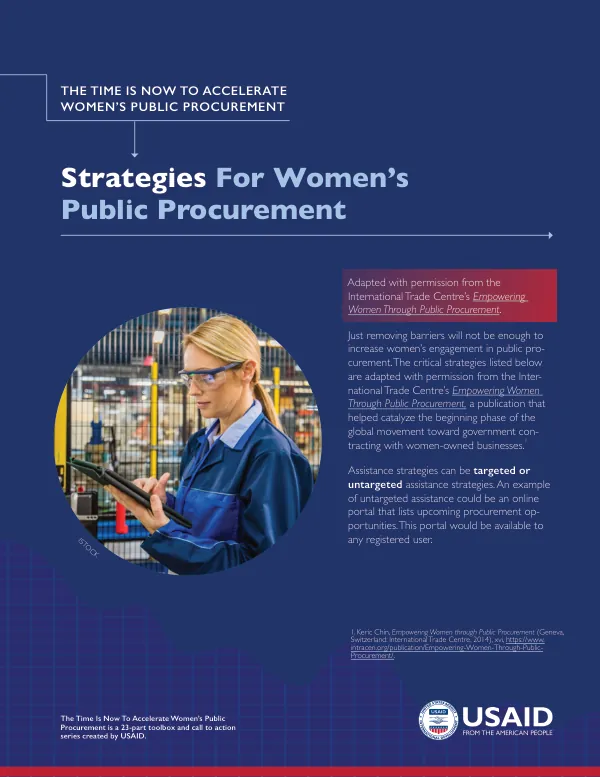
The Time is Now to Accelerate Women's Public Procurement: Strategies for Women's Public Procurement
Sign inBANYAN GLOBAL
The Time is Now to Accelerate Women's Public Procurement: Strategies for Women's Public Procurement
The Time Is Now To Accelerate Women's Public Procurement is a 23-part toolbox and call to action series created by USAID.
2021 · 2 pages
Sign in to readA free account is required to download.
Abstract
The initiative aims to increase women's engagement in public procurement by implementing critical strategies. Assistance strategies can be targeted or untargeted. Untargeted assistance strategies, such as online portals listing upcoming procurement opportunities, are available to all registered users. Targeted assistance strategies specifically encourage women-owned firms and other disadvantaged groups to participate in public procurement. These strategies include creating mandatory goals or targets, such as the 5 percent goal in the United States, which sets aside a portion of contracts for small businesses. Governments can also use subcontracting plans to leverage the buying power of large prime contractors and enable small firms to access public procurement contracts. Another strategy is to build in a price preference or margin of preference to firms eligible for preferential treatment. This involves artificially increasing the bid price of non-preferred firms while making no adjustments to the bid prices of preferred firms. Award is then made to the firm with the lowest evaluated price. For example, South Africa's Broad-Based Black Economic Empowerment program uses this approach. Reservations or set-asides can also be effective in certain contexts. These involve setting aside one or more procurement opportunities for competition among a preferred category of firms, such as women-owned businesses. However, some countries are opposed to set-asides, and the European Union has rejected a set-aside for women-owned businesses as a form of "positive discrimination." In 2013, Kenya announced it would reserve 30 percent of government contracts for women, youth, and persons with disabilities. Capacity-building programs are also an important component of a comprehensive preferential procurement system. Governments can create programs that build the capacity of women-owned firms to compete successfully in public procurement. Women's business associations can be important partners in curriculum building. For example, the U.S. case study highlights the role that women-owned businesses played in developing a curriculum for federal procurement. The International Trade Centre also has an online curriculum focused on women's public procurement.