USAID DEC
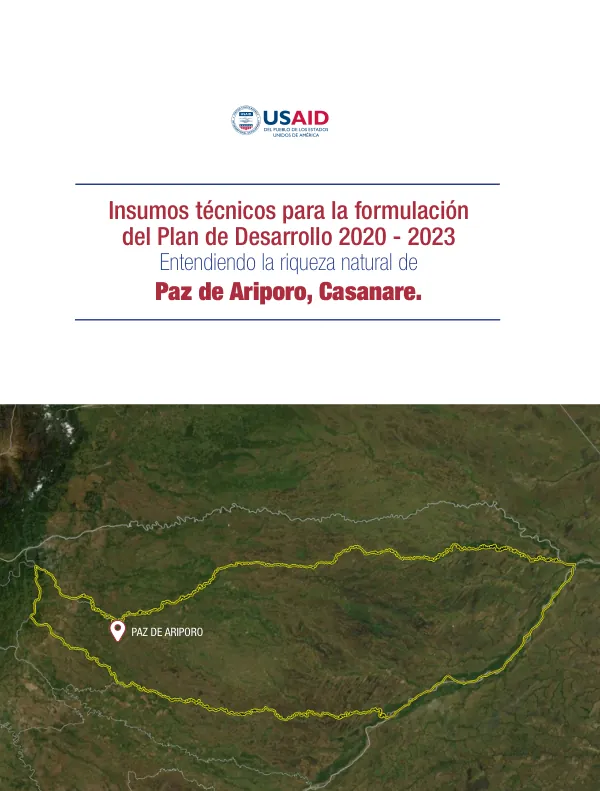
Insumos técnicos para la formulación del Plan de Desarrollo 2020 - 2023 de Paz de Ariporo, Casanare
Sign inIDEAM
Insumos técnicos para la formulación del Plan de Desarrollo 2020 - 2023 de Paz de Ariporo, Casanare
The municipality of Paz de Ariporo, located in the department of Casanare, Colombia, covers an area of 1,380,000 hectares and has a population of 25,324 inhabitants, according to the 2005 census.
2020 · 15 pages
Sign in to readA free account is required to download.
Abstract
The main economic activities in the municipality are livestock, agriculture, and oil exploitation. The municipality has a diverse geography, with a range of altitudes from 72 to 1,565 meters above sea level. The municipality is characterized by a high percentage of natural ecosystems, with 92% of its area presenting natural ecosystems, according to the IDEAM (2017). The main ecosystems in the municipality are savannas, which cover 80% of the area, followed by forests, which cover 9%. The remaining 2% of the area is occupied by agroecosystems. The municipality has a rich biodiversity, with a high concentration of species, including birds, reptiles, and mammals. The area is also home to several protected areas, including the Resguardo Indígena and the Área de Importancia para la Conservación de Aves (AICA). The municipality is also home to several rivers, including the Río Meta and the Río Casanare. However, the municipality is also facing several threats, including deforestation, which has been concentrated in areas with high biodiversity, such as the morichales, cañanguchales, and congriales. The deforestation has been particularly high in the western part of the municipality, where the piedemonte and the savannas are located. The deforestation has put the conservation of the natural ecosystems at risk, particularly the bosque and the sabana. The municipality is also home to several areas of high concentration of alerts of deforestation, which have been identified by the IDEAM. The areas of high concentration of alerts are located in the western part of the municipality, where the piedemonte and the savannas are located. The areas of high concentration of alerts are also home to several ecosystems, including the bosque fragmentado, the vegetación secundaria, and the agroecosistema. The municipality is also facing several climate-related challenges, including a decrease in precipitation, which has been identified as a threat to the water supply. The municipality is also home to several areas of high concentration of hydrocarbons, which are defined by the ANH (Agencia Nacional de Hidrocarburos) as areas of high energy potential. The municipality has several protected areas, including the Resguardo Indígena and the AICA, which are home to several species of birds, reptiles, and mammals. The municipality is also home to several rivers, including the Río Meta and the Río Casanare. The municipality is facing several challenges, including deforestation, which has been concentrated in areas with high biodiversity, such as the morich