USAID. MISSION TO INDIA
Integrated child development services
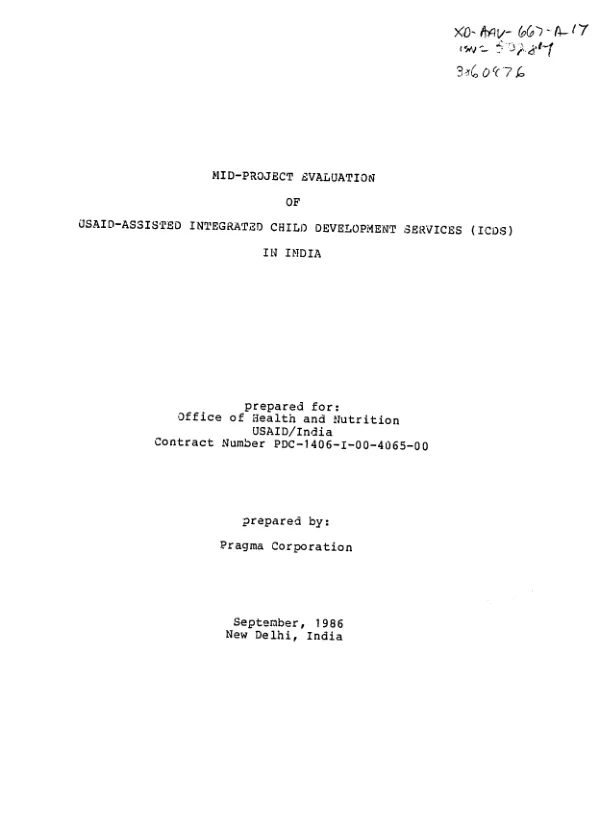
Summarizes external mid-term evaluation (XD-AAV-667-A) of a project to improve delivery of integrated child development services (ICDS) to children under 3 and pregnant or nursing mothers through village child care centers (anganwadis - AWC"s) in 2 districts in the Indian States of Gujarat and Maharashtra.
Sanghvi, Tina; Chaudhuri, Samir +1 more · 1986
Sign in to readA free account is required to download.
Abstract
Evaluation covered 9/83-9/86 and was based on document review, site visits, and interviews with Government of India (GOI) personnel. Construction activities have been successful. The number of AWC"s has risen from 1,211 to 3,376, reaching 2.4 million rural poor (about one AWC for each 700 persons), and on-the-job training has led to large-scale enrollment of target groups and growth monitoring of children. AWC staff have a better understanding of the needs of the target groups, and an average of 20-22 days of Title II food distribution (vs. a targeted 25) is maintained in most project areas, although food supply disruptions continue to occur in Chandrapur. Village-level nutrition and health education (NHED) has not begun, but a marketing/communications package designed with the help of private firms has been tested, strengthening relations with the private sector. Also, monitoring and orientation activities conducted by USAID/I and the TA contractor have helped identify key coordination and integration issues. On the negative side, the invalidity of certain project assumptions has delayed implementation. It sometimes takes 2-3 years for the states to incorporate A.I.D. assistance into their budgets and to authorize activities at the district level. Further, political disturbances in Gujurat during 1984-86 caused lengthy administrative delays, and there have been vacant posts at the state and district levels in both states. These problems have delayed a number of qualitative components involving increased staffing, training, orientation, and community participation. In addition, a key package of health inputs to be delivered through state health departments failed to materialize. Several lessons were learned. (1) The project"s size in terms of area and population proved suitable as a model for improving ICDS. (2) The GOI did not always welcome the intensive efforts made by USAID/I and the contractor; it may not be possible in the future for A.I.D. to undertake innovative projects which attempt to change the status quo in India. (3) Any follow-on should skip the infrastructure phase and focus on improvements in training, management information systems, and NHED in existing ICDS blocks. (4) Much more stress should be placed on coordinating health and ICDS inputs.