USAID. MISSION TO INDIA
Private voluntary organizations for health-II
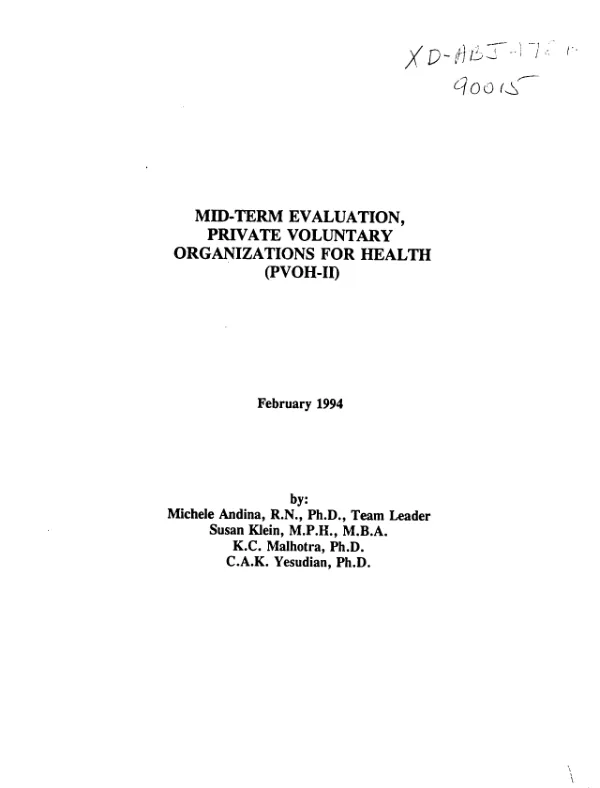
Summarizes attached mid-term evaluation (XD-ABJ-178-A) of a project to fund subgrants to indigenous Indian PVO"s providing maternal/child health and family planning services to underserved populations, mainly in rural areas.
1994
Sign in to readA free account is required to download.
Abstract
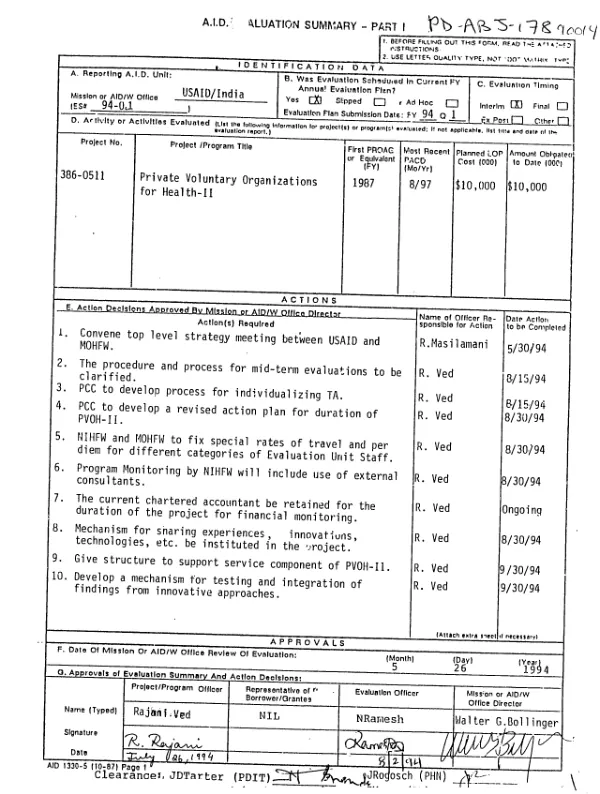
The evaluation covers the period 8/87-2/94. Participating PVOs have shown themselves to be capable, committed, and resourceful in their implementation of subprojects, and have realized significant achievements. PVOs have: (1) expanded their geographical areas of service, improved service quality, and added new services; (2) developed horizontally and vertically integrated health care delivery systems, including some improvements to the service delivery infrastructure; (3) provided quality health services to underserved, remote, and isolated populations; (4) built their capabilities in project formulation and financial management; and (5) strengthened linkages and working relationships with district and primary health center officials to provide complementary and supportive services. However, subprojects suffer from a number of deficiencies. (1) Innovation in health care delivery and allied development activities has been limited; for example, few attempts have been made at integrating traditional and western systems of health care. A restrictive proposal selection process is largely to blame. (2) Community input into local programming has been largely missing, and while considerable training of village health workers and volunteers has taken place, it has been uneven. (3) Infrastructure development has been slow, hampering implementation of other activities. (4) Record keeping and management information systems were weak in many PVOs; the lack of adequate records, and of a strong target orientation, has contributed to gaps in coverage of the perinatal period, especially labor/delivery, postpartum, and neonatal care. (5) Nutrition services lacked the necessary dietary counseling in conjunction with growth monitoring. (6) Specific treatment modalities, e.g., for acute respiratory illness, were not evident. The project"s primary flaws are its "top-down" management approach coupled with an inability to respond in a timely fashion to the needs of PVOs. Proposal selection and subproject monitoring have tended to focus on compliance and numerical targets, while flexibility and problem solving, the forte of PVOs, have not been encouraged. In addition, TA, training, and sharing of experiences, which were to be an integral part of the project, have not been forthcoming. To a large extent, the PVOs have been working on their own in their attempts to implement their programs and expand their horizons. As things now stand, prospects for sustainability are low, as is the potential for cost recovery. Without additional donor support, only a few of the project"s activities -- about 30%, judging from the predecessor project -- are likely to be sustained. The following recommendations are made. (1) The project management system should immediately be revised to facilitate timely response and flexibility. (2) To ease the burden on the implementor, the National Institute of Health and Family Welfare (NIHFW), regional experts should be contracted for technical aspects of subproject monitoring and evaluation, adequate financing should be provided for NIHFW travel and per diem, and reporting requirements and evaluation procedures should be restructured and clarified. (3) Channels for strengthening PVOs" capacities should strengthened, including providing individualized TA, establishing mechanisms for sharing experiences, and giving additional emphasis to the Support Services component of the project. (4) An institutionalization plan should be developed which documents how the Ministry of Health and Family Welfare and PVOs will work together to sustain successful programs.
Related documents