COASTAL RESOURCES CENTER
Integrated Management of Coastal and Freshwater Ecosystems
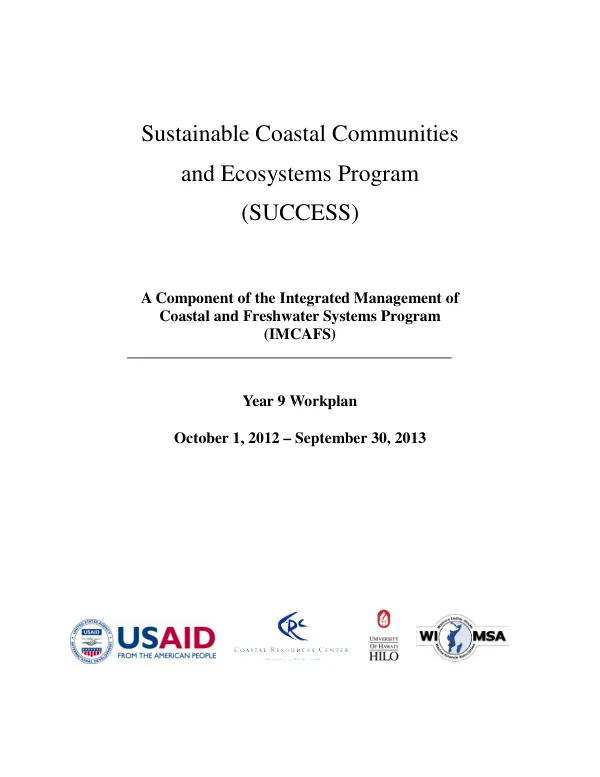
The Sustainable Coastal Communities and Ecosystems Program, also known as SUCCESS, is a component of the Integrated Management of Coastal and Freshwater Systems Program (IMCAFS).
2012 · 47 pages
Sign in to readA free account is required to download.
Abstract
The program's goal is to provide global leadership in integrated coastal management through innovative approaches in a participatory, issue-driven, and results-oriented process. The program aims to promote sustainable use of marine resources, conserve marine biodiversity, and improve food and income security. The program's first five years were focused on achieving tangible on-the-ground results, increasing capacity through certification initiatives and on-the-ground training, establishing regional learning networks supported by knowledge management, and applying science to management and good governance. In the five-year extension, the program is focusing on three major areas: increasing capacity for marine protected area (MPA) professionals through certification, applying a climate lens to coastal policy, management, and practice, and capturing and disseminating key learning about livelihoods development. The program's work is guided by the USAID Strategic Goals and Regional Priority Interests, which include promoting coastal adaptations to climate change, increasing capacity for effective management of marine protected areas, and collaborative learning. The program is also focused on biodiversity conservation and plays a role in raising awareness of the need to adapt coastal policies, plans, and practices in the face of global climate change. The program's leadership activities at the global level include certification of MPA professionals, climate change adaptation for the coast, and lessons learned in promoting conservation-based livelihoods. The program is also working on finalizing the Fisheries and Aquaculture Guide for USAID. The program's partners include the Coastal Resources Center at the University of Rhode Island, the Pacific Aquaculture and Coastal Resources Center at the University of Hawaii, and the Western Indian Ocean Marine Science Association. The program's budget for the five-year extension is $300,000 per year, with a revised ceiling of $5,600,000. The program's work is being implemented in several countries, including Tanzania, Nicaragua, and Ecuador. The program's success is measured through the achievement of its goals and objectives, including the promotion of sustainable use of marine resources, conservation of marine biodiversity, and improvement of food and income security. The program's certification initiative for MPA professionals is a key component of its work. The initiative, known as the MPA PRO network, recognizes the importance of professional certification in promoting effective management of marine protected areas. The program is also working on applying a climate lens to coastal policy, management, and practice, and capturing and disseminating key learning about livelihoods development. The program's work is guided by a participatory, issue-driven, and results-oriented approach. The program is working closely with its partners and stakeholders to achieve its goals and objectives. The program's success is dependent on the effective implementation of its activities and the achievement of its goals and objectives. The program's budget is allocated to several key areas, including leadership activities, certification initiatives, climate change adaptation, and livelihoods development. The program's budget is also allocated to the development of the Fisheries and Aquaculture Guide for USAID. The program's budget is managed by the program's leadership team, which includes the program director, deputy directors, and other key staff members. The program's monitoring and evaluation activities are designed to track the program's progress and achievement of its goals and objectives. The program's monitoring and evaluation activities include the collection of data and information on the program's activities, outcomes, and impacts. The program's monitoring and evaluation activities are also designed to identify areas for improvement and to inform the program's future activities. The program's success is dependent on the effective implementation of its activities and the achievement of its goals and objectives. The program's leadership team is committed to ensuring that the program's activities are implemented effectively and that the program's goals and objectives are achieved.
Related documents