USAID. MISSION TO ECUADOR
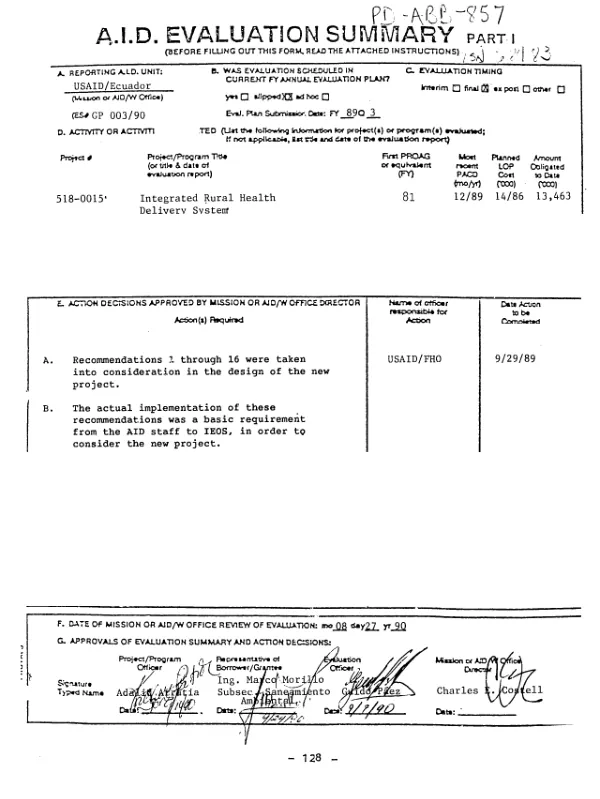
Integrated rural health delivery system
Summarizes final evaluation (PD-AAZ-655) of a project to establish a decentralized water supply and sanitation system in rural Ecuador.
1990
Sign in to readA free account is required to download.
Abstract
The evaluation covered the period FY81-FY89. Logistical problems and lack of transportation hampered the achivement of construction and promotion goals. Compared with the target of 18 systems per year, each construction team was able to build only 6 to 7 systems per year. Nonetheless, the team construction method, called an "operational module," was an efficient means of decentralizing construction. The average cost of each system was about $22,000. Little attention was paid to health education, and improvement needs to be made in sanitation education, particularly in latrine promotion, construction, and water usage. Although some 1,200 project-related personnel received training from the Ecuadorean Institute of Sanitary Works, this training primarily focused on manual skills, with less emphasis on promotional skills, hygiene, and health. As a result, many communities do not understand the health benefits of latrine use, and latrines with concrete pour- flush devices are not being used because people find them hard to clean and unaesthetic. Moreover, while the project is a vital element in child survival efforts, the project"s prospective social marketing approach does not target the usual caretakers of children such as older children, grandparents, and other extended family members. One of the strongest achievements of the project was the establishment of community ownership and management of rural water supply and sanitation systems. It is estimated that the community water systems and community water boards established under the project are being operated and maintained in the proportion of 60% good, 20% fair, and 20% poor. The concept of local participation, ownership, and self-management was totally institutionalized. However, community-determined and enforced tariffs are too low to cover recurrent costs in most systems, and very few community water boards adjust rates annually as they should. Neither USAID/E nor the Government of Ecuador used need-based criteria in the selection of beneficiary communities. USAID/E placed priority on a community"s proximity to the office, community demand, and technical feasibility.