USAID DEC
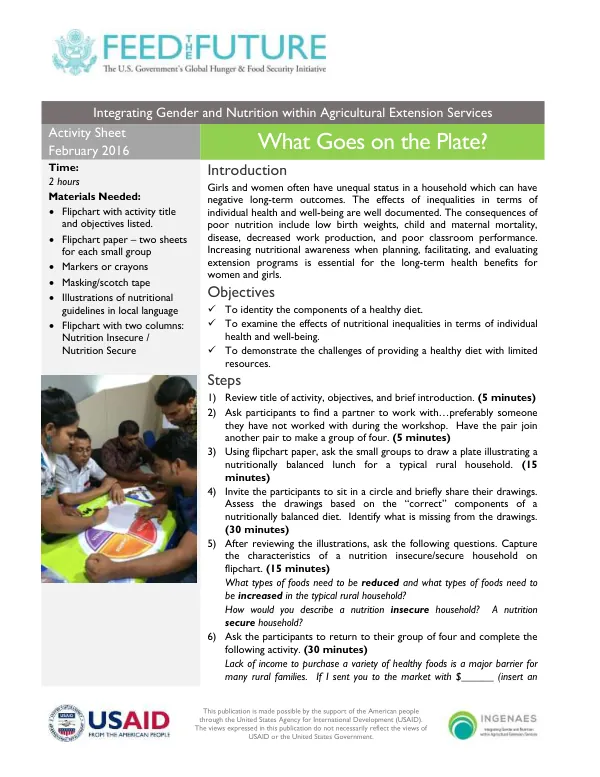
Integrating Gender and Nutrition within Agricultural Extension Services Activity Sheet
Sign inFAO
Integrating Gender and Nutrition within Agricultural Extension Services Activity Sheet
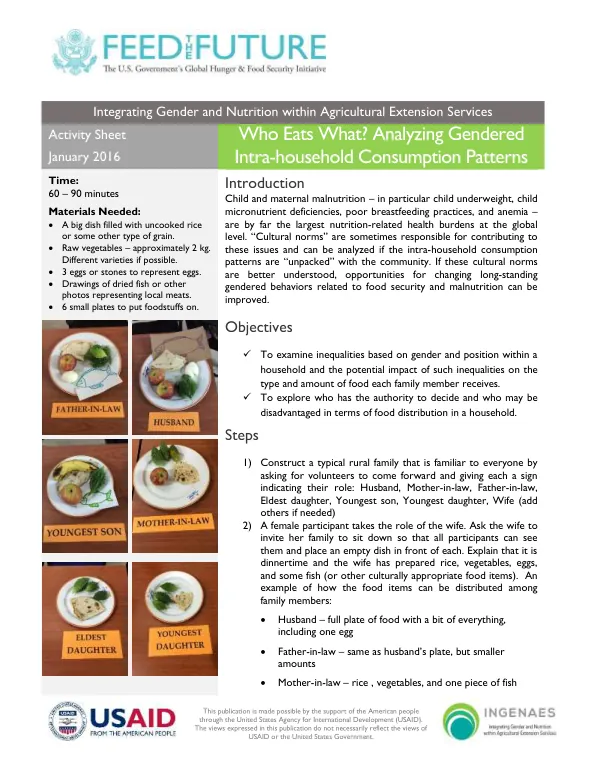
The Integrating Gender and Nutrition within Agricultural Extension Services Activity Sheet is a training tool designed to analyze gendered intra-household consumption patterns.
2016 · 2 pages
Sign in to readA free account is required to download.
Abstract
The activity, titled "Who Eats What?", aims to examine inequalities based on gender and position within a household and the potential impact of such inequalities on the type and amount of food each family member receives. The activity involves constructing a typical rural family with volunteers, each representing a different household member, including the husband, mother-in-law, father-in-law, eldest daughter, youngest son, youngest daughter, and wife. The wife is then asked to invite her family to sit down and place an empty dish in front of each participant, representing dinnertime. The food items, including rice, vegetables, eggs, and fish, are then distributed among the family members, with some receiving more food than others. The activity is designed to facilitate discussion and exploration of who has the authority to decide and who may be disadvantaged in terms of food distribution in a household. Participants are asked to respond to questions such as why some family members get more food than others, what gives some family members more access to food than others, and who decides how much and what each family member will get to eat. The activity is intended to be shared and can be adapted for different audiences and contexts. The resources section of the activity sheet provides additional information and references, including the Food and Agriculture Organization of the United Nations' Food Based Dietary Guidelines and The State of Food and Agriculture: Food systems for better nutrition. The activity is part of a broader effort to address child and maternal malnutrition, particularly child underweight, child micronutrient deficiencies, poor breastfeeding practices, and anemia, which are significant nutrition-related health burdens at the global level. By examining and addressing the cultural norms and gendered behaviors related to food security and malnutrition, opportunities for improving nutrition outcomes can be improved. The activity is designed to be completed within 60-90 minutes and requires a big dish filled with uncooked rice or other grain, raw vegetables, eggs or stones to represent eggs, drawings of dried fish or other photos representing local meats, and 6 small plates to put foodstuffs on. The activity is a tool for training and capacity building in the area of gender and nutrition within agricultural extension services.