USAID DEC
Integrating Variable Renewable Energy in Power Systems: Fundamentals for the Greater Mekong Subregion
Sign inDEPARTMENT OF ENERGY
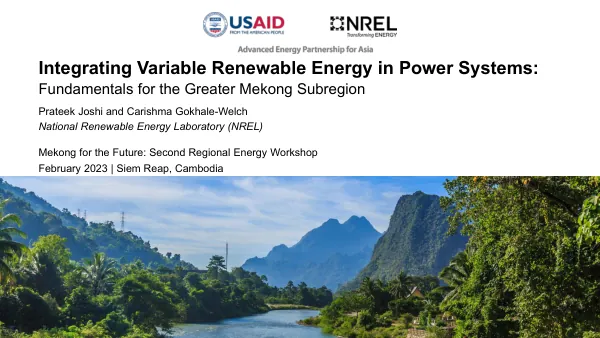
Integrating Variable Renewable Energy in Power Systems: Fundamentals for the Greater Mekong Subregion
The integration of variable renewable energy (VRE) in power systems is a critical aspect of the Greater Mekong Subregion's energy landscape.
2023 · 76 pages
Sign in to readA free account is required to download.
Abstract
The region's energy demand is projected to increase significantly, driven by economic growth and urbanization. To meet this demand, the region must transition towards a more sustainable and secure energy mix. Renewable energy generation capacity represents the majority share of new additions globally. At the end of 2021, global renewable generation capacity stood at 3,064 GW, with solar and wind accounting for 88% of new RE capacity. The Greater Mekong Subregion has seen significant growth in renewable energy capacity, with 60% of new renewable capacity installed in 2021 being in Asia. The region's installed capacity of renewable energy includes solar, wind, hydropower, and biofuels. The benefits of integrating VRE into the region's power systems are numerous. Meeting government goals and targets, providing a low-cost option to serve growing demand, reducing pollution and health benefits, supporting energy access, and enhancing energy security and resilience are some of the key advantages. The region's government goals and targets for renewable energy integration are ambitious, with countries such as Cambodia, Laos, and Myanmar aiming to increase their renewable energy share in the energy mix. Advances in renewable energy technology have made it more viable and cost-effective. Solar photovoltaic (PV) cell efficiencies have improved significantly, with the highest confirmed efficiencies reaching 24.8%. Wind turbine technology has also seen significant advancements, with average turbine nameplate capacity, hub height, and rotor diameter increasing over the years. Vietnam, in particular, has seen significant growth in wind turbine technology, with the largest turbine rotor diameters on average in 2021. The USAID-NREL Partnership has been working to support the integration of VRE in the Greater Mekong Subregion. The partnership's global technical platforms provide free, state-of-the-art support on common and critical challenges to scaling up advanced energy systems. The partnership's work focuses on improving energy utility planning and operational practices, fostering more supportive policy, legal, and regulatory environments, and increasing the use and availability of high-quality data to drive energy sector analysis and decision-making. The region's energy sector is expected to undergo significant changes in the coming years, driven by the increasing adoption of VRE. To ensure a smooth transition, it is essential to develop and implement effective decision-making tools and strategies. The RE Data Explorer is one such tool that provides a comprehensive platform for analyzing and visualizing renewable energy data. The tool enables users to explore and analyze data on renewable energy capacity, generation, and market trends, providing valuable insights for decision-making. The integration of VRE in the Greater Mekong Subregion presents both opportunities and challenges. Managing increasing VRE levels requires careful planning and coordination to ensure a stable and secure energy supply. The region must develop and implement effective solutions to address the challenges associated with VRE integration, such as grid stability, energy storage, and transmission infrastructure.
Related documents