USAID DEC
Intégration des soins et soutien nutritionnels dans la prise en charge globale des personnes vivant avec le VIH
Sign inFANTA
Intégration des soins et soutien nutritionnels dans la prise en charge globale des personnes vivant avec le VIH
In Côte d'Ivoire, the prevalence of HIV infection is 3.7% in the general population, making it one of the countries most affected by the disease in West Africa.
2018 · 8 pages
Sign in to readA free account is required to download.
Abstract
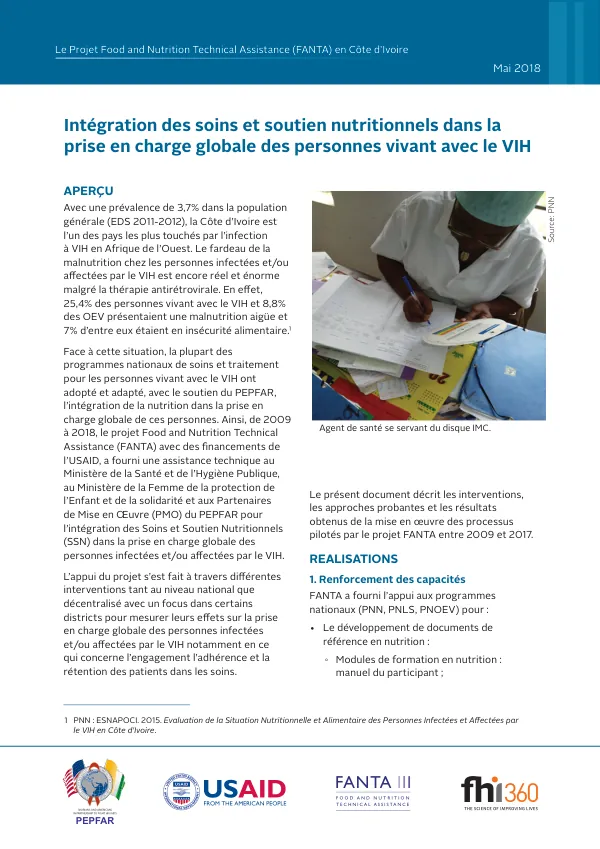
The burden of malnutrition among people living with HIV is still significant, with 25.4% of those infected and 8.8% of orphans and vulnerable children (OVC) experiencing acute malnutrition. The Food and Nutrition Technical Assistance (FANTA) project, funded by USAID, has provided technical assistance to the Ministry of Health and Hygiene, the Ministry of Women, Child Protection, and Solidarity, and the Partners Implementing (PMO) of PEPFAR for the integration of Nutrition Support Services (SSN) into the comprehensive care of people living with HIV. The FANTA project has provided support to national programs (PNN, PNLS, PNOEV) for the development of nutrition reference documents, including modules of formation in nutrition, algorithms and posters for the care of malnutrition, and aids-memoires for care and nutrition support. The project has also trained 23 national trainers in 2012, 56 regional health trainers in 2014, and 21 trainers of social workers in eight health regions in 2015. Additionally, the project has equipped 514 health structures with 1160 BMI disks for the evaluation of the nutritional status of adolescents and adults. The project has also created a dynamic framework for the coordination of nutrition and HIV activities, involving actors from the health, social, and community sectors, PMO, national partners, and international partners involved in the care of people living with HIV. This framework has allowed for the sharing of experiences on the issue of nutrition and HIV and the resolution of factual problems, such as the management of specialized food products for people living with HIV during the 2011 socio-political crisis. The project has also supported the development of a protocol for the integrated care of malnutrition, the elaboration of two documents of good practices on the implementation of processes, and the realization of three operational studies. The project has also developed 14 national reference documents in nutrition, detected 126 (92.6%) malnourished patients who were HIV-positive and enrolled in HIV treatment, and trained 315 healthcare providers in nutrition and HIV care.