USAID DEC
Interpretation of Bouguer Anomaly to Determine Fault and Subsurface Structure at Blawan-Ijen Geothermal Area
Sign inUSAID DEC
Interpretation of Bouguer Anomaly to Determine Fault and Subsurface Structure at Blawan-Ijen Geothermal Area
The Blawan-Ijen geothermal area is located in the Blawan-Ijen area, East Java, Indonesia.
2016 · 9 pages
Sign in to readA free account is required to download.
Abstract
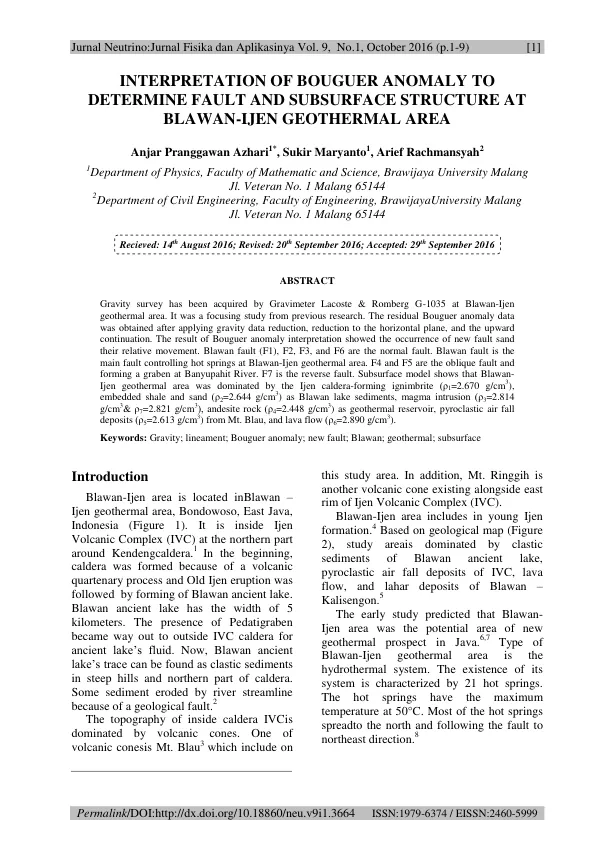
The area is dominated by volcanic cones, with one of the cones being Mt. Blau. The Blawan-Ijen area is a young Ijen Volcanic Complex (IVC) with a width of 5 kilometers. The area is characterized by the presence of Pedatigra, a way out for the ancient lake's water. The Blawan-Ijen area has a complex geological structure, with the presence of faults and subsurface faults. The faults are identified as Blawan fault (F1), F2, F3, and F4, and F7. The Blawan fault is a normal fault, while F4 and F5 are oblique faults that form a graben at Banyupahit River. F7 is a reverse fault. The subsurface model of the Blawan-Ijen area shows the presence of Ijen caldera-form ignimbrite, embedded shale and sand, magma intrusion, andesite rock, pyroclastic air fall deposits, and lava flow. The subsurface model is used to identify the subsurface structure and faults in the area. The Bouguer anomaly maps and subsurface models are used to identify the subsurface structure and faults in the Blawan-Ijen area. The Bouguer anomaly maps show low, medium, and high Bouguer anomalies, which are used to identify the subsurface structure and faults in the area. The subsurface models are used to identify the subsurface structure and faults in the Blawan-Ijen area. The Blawan-Ijen area is a promising area for geothermal exploration, with the presence of hot springs and a hydrothermal system. The area has a complex geological structure, with the presence of faults and subsurface faults. The subsurface model of the Blawan-Ijen area shows the presence of Ijen caldera-form ignimbrite, embedded shale and sand, magma intrusion, andesite rock, pyroclastic air fall deposits, and lava flow.