USAID DEC
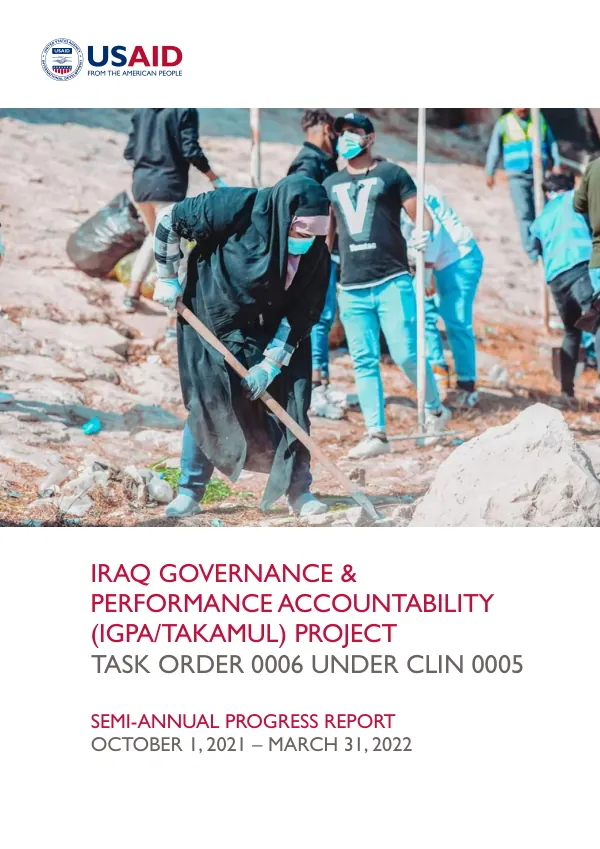
Iraq Governance & Performance Accountability (IGPA/Takamul) Project Task Order 0006: Semi-Annual Progress Report October 1, 2021 – March 31, 2022
Sign inDAI
Iraq Governance & Performance Accountability (IGPA/Takamul) Project Task Order 0006: Semi-Annual Progress Report October 1, 2021 – March 31, 2022
The Iraq Governance and Performance Accountability project (IGPA/Takamul) aims to advance effective, accountable, and transparent governance in Iraq.
2022 · 39 pages
Sign in to readA free account is required to download.
Abstract
Task Order 6: Climate Change Governance Activities is providing technical assistance to the Government of Iraq (GOI) to improve its efforts in addressing climate change issues. This task order focuses on strengthening governance by improving decision making, planning, resourcing, and the creation of policy, regulatory, and legislative frameworks that will support climate change action and build the resilience of GOI institutions at all levels. The core tasks involve a mixture of mitigation and adaptation activities and reflect IGPA's experience and lessons learned in key service delivery sectors of water, solid waste, electricity, and agriculture. The tasks include improving climate change governance in the electricity, water, solid waste management, and agriculture sectors, supporting the Government of Iraq to increase public awareness, engage citizens, and prepare for participation in the 26th United Nations Climate Change Conference of the Parties (COP26), and assisting governance structures at the provincial level to play a meaningful role in this overall effort. Significant accomplishments of IGPA/Takamul Task Order 6: Climate Change Governance Activities during the period of October 2021 through March 2022 include conducting an awareness campaign targeting different levels of society to promote and popularize solar power as an alternative to generators that run on fossil fuels and cause harmful emissions to the environment. A solar power guidebook was developed to address questions asked by citizens during the campaign and provide practical information for citizens in using the solar power. In the solid waste management sector, studies were conducted on methane gas emissions in three typical landfills, considered a critical cause of climate change. IGPA provided criteria for evaluating the feasibility of methane gas capture systems in landfills, managing organic waste, and preparing strategic plans to introduce new methods into standard operating procedures. A committee was formed to develop proposed amendments to the Solid Waste Management (SWM) Law incorporating methane capture in landfills. In the agriculture sector, a guidebook was developed that includes user-friendly information on the impact of climate change on the agriculture sector. The guidebook includes practical ideas and explanations of the climate-smart practices, the short-term and long-term benefits of applying these practices, and the long-term consequences of continuing to use certain current farming practices. An awareness drive was conducted for selected farmers and agricultural entities in seven provinces to improve their knowledge of the climate change impacts on the agriculture sector. Climate change governance at the provincial level was also a focus area, with the reactivation of the Provincial Environmental Development and Protection Councils in several provinces. These councils play a crucial role in promoting environmental protection and improvement at the provincial level. The councils were reactivated through a series of workshops and training sessions, which aimed to enhance their capacity to address climate change issues and promote sustainable development. The project has made significant progress in its first six months, with several key accomplishments in the areas of climate change governance, public awareness, and provincial level engagement. The project's work plan was approved by USAID on August 8, 2021, for an implementation period of 15 months. The project's overall goal is to support the Government of Iraq in its efforts to address climate change issues and promote sustainable development in the country.
Related documents