USAID DEC
USAID Iraq Governance and Performance Accountability (IGPA) Activity Rapid Assessment Report
Sign inINTEGRATED INTERNATIONAL
USAID Iraq Governance and Performance Accountability (IGPA) Activity Rapid Assessment Report
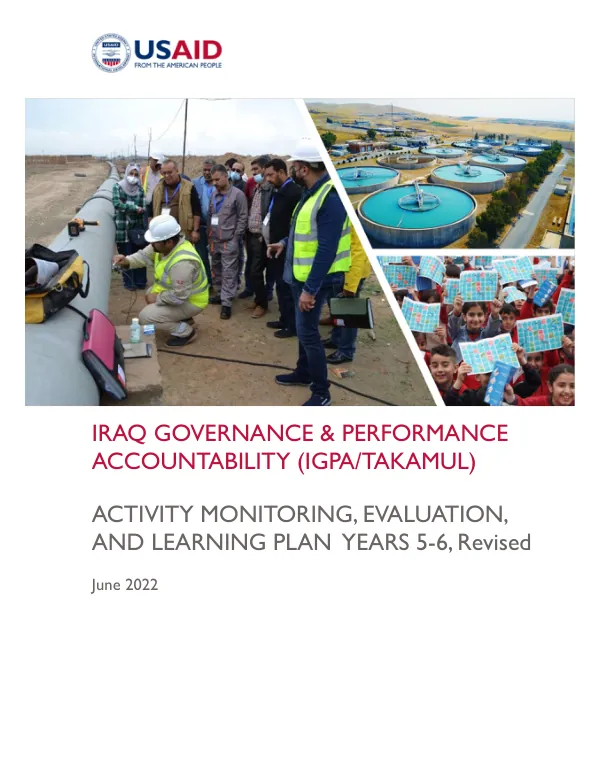
The USAID Iraq Governance and Performance Accountability (IGPA) project is a six-year series of activities with a budget of $172 million, implemented by Development Associates International (DAI).
2022 · 85 pages
Sign in to readA free account is required to download.
Abstract
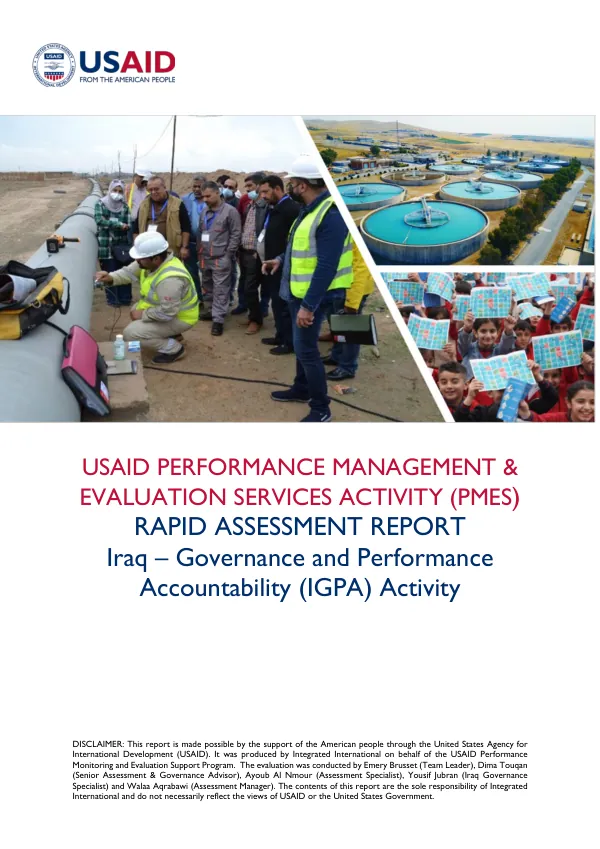
The project's goal is to improve the Government of Iraq's (GOI) credibility with its citizens by strengthening the GOI's ability to effectively deliver services across the country to the general population. IGPA also aims to help local and federal government institutions to better respond to citizens' needs by supporting reform initiatives and empowering Iraqi change agents to promote inclusive governance. The primary purpose of this assessment is to inform the design of a new governance activity in Iraq, with a focus on USAID program management. The resulting recommendations will also guide IGPA during the last 18 months of implementation. The assessment employed a qualitative approach that examined the project and its achievements and highlighted learning to inform the design of a new governance activity. Alongside document analysis, data collection included primary and secondary methods, including a desk review and key informant interviews. Results achieved under Objective 1 contribute to the legal environment and capacities of staff, particularly in the development of the legal framework for PPP, Public Procurement, service delivery process streamlining, and the solid waste management (SWM) draft laws. For Objective 2, the key goal is to facilitate Government revenue and expenditure, which was achieved through cost recovery models and better tracking of revenue, while also boosting support for strategic initiatives. The principal results have been the improvement in resource tracking, and an increased ability to frame strategic priorities. Under Objective 3, the project supported citizen participation, communication, and outreach. The assessment team observed that the mechanisms improved relations between government and civil society and enhanced the ability of citizens to channel their concerns. All interviewed external Change Agents reported a notable increase in the access of CSOs, women, and minority populations to governmental decision making, creating reinforcing effects to their work at the provincial and federal levels. While the project has achieved a good fit with local conditions, results remain dependent on Iraqi political will. This is a structural issue that affects program impact; IGPA can partially adjust for this with Embassy support and can make pragmatic adjustments and deploy highly qualified personnel. Since governance results will always depend on political will, it is wise that IGPA developed these methods to adapt to conditions. The project has provided both a continuity of approach to complex processes of public financial management and the ability to respond positively to emerging institutional dynamics. For Objective 3, the Government of Iraq's commitment is perceived to be low as newly established administrative structures do not have the necessary authority, mandate, or political support. In addition, the sustainability of civil society engagement fora such as the Social Accountability Groups (SAGs) and Technical Working Groups (TWGs) is contingent on the provincial governments' ownership of these mechanisms and their continued support. Options available within the existing framework lie mostly in the need to follow up and consolidate initiatives. This includes a more deliberate interface with planning departments, expanding the limited knowledge of the project's objectives and achievements that Assessment respondents exhibited during interviews. The most significant potential gains that emerge, objective by objective, revolve around the use of specific assets created by the project. These can be described in three broad categories: the creation of better data and its dissemination via increased digitalization, leveraging financing, and encouraging dynamic informal networks of like-minded individuals. The Monitoring, Evaluation, and Learning function of IGPA is the fruit of a prolonged development that combines standard output and outcome indicators with the innovative potential of complexity thinking and impact level indicators. There is a thorough capture of the implementation of specific measures, and the systematic tracking of quantitative multi-year targets, which tend to skew the focus towards short-term achievements.