USAID DEC
IRIS Data Brief: Focus on Employment
The IRIS initiative is a catalog of generally-accepted performance metrics used to measure an organization's social, environmental, and financial results.
2013 · 7 pages
Sign in to readA free account is required to download.
Abstract
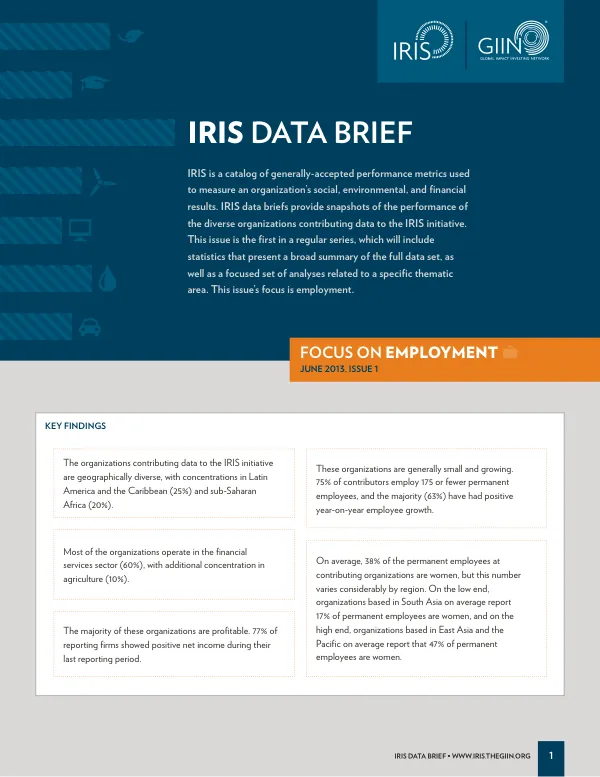
The initiative provides data briefs that offer snapshots of the performance of organizations contributing data to the IRIS initiative. This issue focuses on employment and presents a broad summary of the full data set, as well as a focused set of analyses related to employment. The organizations contributing data to the IRIS initiative are geographically diverse, with concentrations in Latin America and the Caribbean (25%) and sub-Saharan Africa (20%). Most of the organizations operate in the financial services sector (60%), with additional concentration in agriculture (10%). The majority of these organizations are profitable, with 77% of reporting firms showing positive net income during their last reporting period. These organizations are generally small and growing, with 75% employing 175 or fewer permanent employees. The majority (63%) have had positive year-on-year employee growth. On average, 38% of permanent employees at contributing organizations are women, but this number varies considerably by region. Organizations based in South Asia on average report 17% of permanent employees are women, while those based in East Asia and the Pacific on average report 47% of permanent employees are women. The data brief presents a range of statistics related to employment, including the number of organizations contributing data to the IRIS initiative (4,090), the number of countries represented (128), and the average years in business (15). The earned revenue of contributing organizations is nearly USD 265 billion, while 77% are profitable. The organizations serve more than 131 million clients and employ over 600,000 permanent employees. The sectoral distribution of contributing organizations is also presented, with financial services being the most commonly reported sector affiliation, both across and within geographic regions. Organizations focused on agriculture are also common, with the majority located in Latin America and the Caribbean and sub-Saharan Africa. There is most sectoral variety in Latin America and the Caribbean and sub-Saharan Africa, with financial services organizations comprising over 80% of all organizations in other regions. The data brief also presents box-and-whisker plots to summarize the main features of data sets and the degree of variability in values within them. The plots show the 25th percentile, median, 75th percentile, 10th percentile, and 90th percentile for various metrics, including permanent employees and female permanent employees by region. The median number of permanent employees is 47, while the average is 300. In addition, 75% of contributing organizations have 175 employees or fewer. While there is a relatively wide range of number of employees per company in each region, overall, the median number of employees across regions is fewer than 200. Organizations headquartered in South Asia are the largest in terms of median permanent employees, followed by those in Middle East and North Africa and East Asia and Pacific. The smallest are in North America and Europe and Central Asia. There is wide variability in the median percentage of women employed by contributing organizations, ranging from 10% in South Asia to 45% in East Asia and Pacific. While contributing organizations in South Asia report the largest number of permanent employees, they employ the lowest percentage of female permanent employees on average, significantly lower than those in other regions. The median percentages of females employed in organizations in Europe and Central Asia and North America are notably low at 35% and 33% respectively. Organizations headquartered in East Asia and Pacific also have the least variability in female employee proportions, ranging from 21% at the 10th percentile to 64% at the 90th percentile.
Related documents