POPULATION REFERENCE BUREAU
2020 World Population Data Sheet
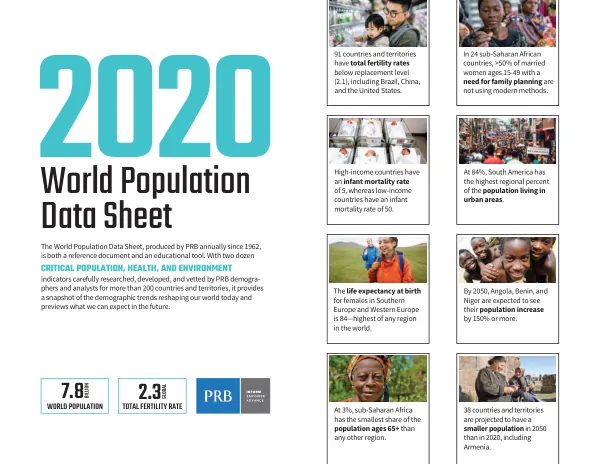
The global population is projected to reach 9.7 billion by 2050, with 91 countries and territories having total fertility rates below the replacement level of 2.1.
2020 · 22 pages
Sign in to readA free account is required to download.
Abstract
Sub-Saharan Africa has the smallest share of the population ages 65+, with only 3% of the population in this age group. In 24 sub-Saharan African countries, more than 50% of married women ages 15-49 with a need for family planning are not using modern methods. High-income countries have an infant mortality rate of 5, while low-income countries have an infant mortality rate of 50. By 2050, Angola, Benin, and Niger are expected to see their population increase by 150% or more. The life expectancy at birth for females in Southern Europe and Western Europe is 84, the highest of any region in the world. At 84%, South America has the highest regional percent of the population living in urban areas. The World Population Data Sheet, produced annually by PRB since 1962, provides a snapshot of demographic trends reshaping the world today and previews what can be expected in the future. The data sheet carefully researches, develops, and vets critical population, health, and environment indicators for more than 200 countries and territories. It serves as both a reference document and an educational tool. The data sheet highlights that 26 countries and territories have 40% or more of their populations living in cities of 1 million or more. These countries may experience difficulties curbing the spread of infectious diseases like COVID-19 due to high population density and limited access to safe water and sanitation. Average household size varies substantially around the world, with Western Africa and Middle Africa having the largest average household size at 5.1. Large household size and multigenerational living may influence people's ability to limit exposure to the coronavirus at home. Many factors contribute to vulnerability to a pandemic, including population density in urban areas, household size, and population aging. Older populations are at high risk for becoming seriously ill with COVID-19, with 21 countries and territories having a share of the population ages 65+ of 20% or higher. The World Population Data Sheet provides detailed data on population trends, including birth rates, death rates, natural increase rates, and migration rates, for more than 200 countries and territories.