USAID DEC
IRIS Working Groups IRIS+ Upgrade
Impact investing seeks to integrate social and environmental factors into investment decisions, aiming to create a world where these considerations are routine.
2019 · 30 pages
Sign in to readA free account is required to download.
Abstract
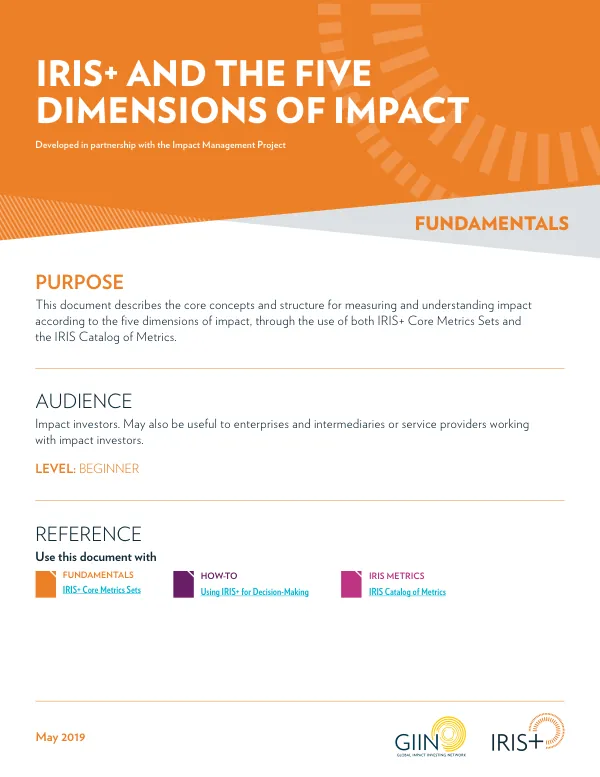
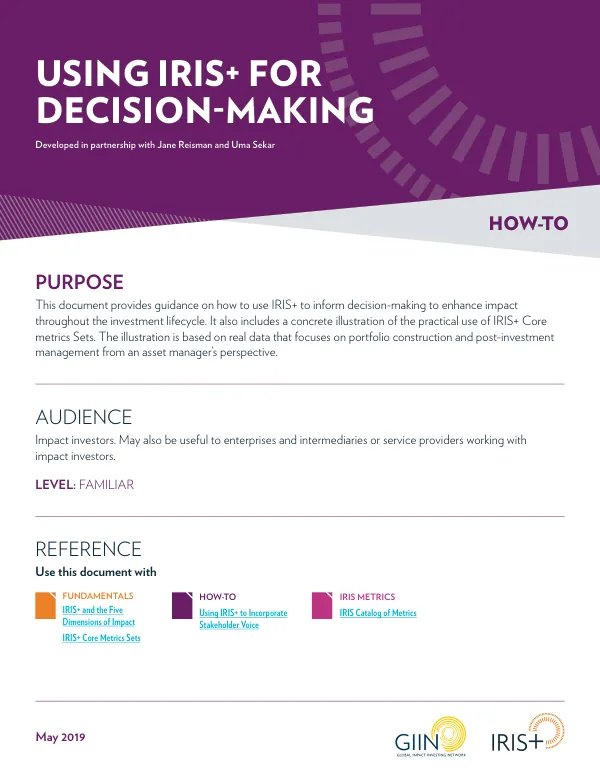
The Global Impact Investing Network (GIIN) and the Impact Management Project (IMP) collaborate to advance the field through the development of standards and guidance. The GIIN's focus is on scaling impact investing with integrity, emphasizing the need for consistent and high-quality impact management practice. This involves measuring and disclosing negative and positive impacts, comparing impacts to identify areas for improvement, and mitigating or minimizing negative impacts while increasing positive ones. The IMP's strategy is to produce clear standards and guidance on impact management practice, including processes for measuring impacts, disclosing data, and comparing impacts. The IMP facilitates collaboration among practitioners to establish norms for ESG and impact measurement, management, and reporting. This effort has brought together over 2,000 practitioners to agree on the dimensions of performance that matter for ESG and impact measurement. The IMP's Structured Network is an unprecedented collaboration of 12 standard-setting organizations, leveraging their expertise to develop technical end-to-end guidance. This network aims to provide a logic for sharing information about ESG and impact goals and performance across value chains, from the people and planet affected to enterprises, investment intermediaries, advisors, and asset owners. The five dimensions of impact are a key aspect of the IMP's work. These dimensions provide a framework for understanding and managing impact, enabling practitioners to identify areas for improvement and develop strategies to mitigate negative impacts and increase positive ones. The dimensions are designed to be used in conjunction with the IRIS+ framework, which provides a set of metrics and indicators for measuring impact. The IRIS+ framework is a tool for managing impact along the five dimensions. It provides a structured approach to impact measurement and management, enabling practitioners to identify and address areas of impact. The framework is designed to be flexible and adaptable, allowing practitioners to tailor their approach to their specific needs and goals. The use of IRIS+ is intended to help practitioners manage impact along the five dimensions, providing a clear and consistent approach to impact measurement and management. By using IRIS+, practitioners can identify areas for improvement, develop strategies to mitigate negative impacts, and increase positive impacts. This, in turn, can help to improve performance and contribute to the achievement of social and environmental goals.
Related documents