USAID. MISSION TO SENEGAL
Irrigation and water management I
Summarizes interim evaluation (XD-ABC-440-A) of a pilot project to develop village irrigated perimeters (PIV"s) in Senegal"s Bakel Delegation.
1991
Sign in to readA free account is required to download.
Abstract
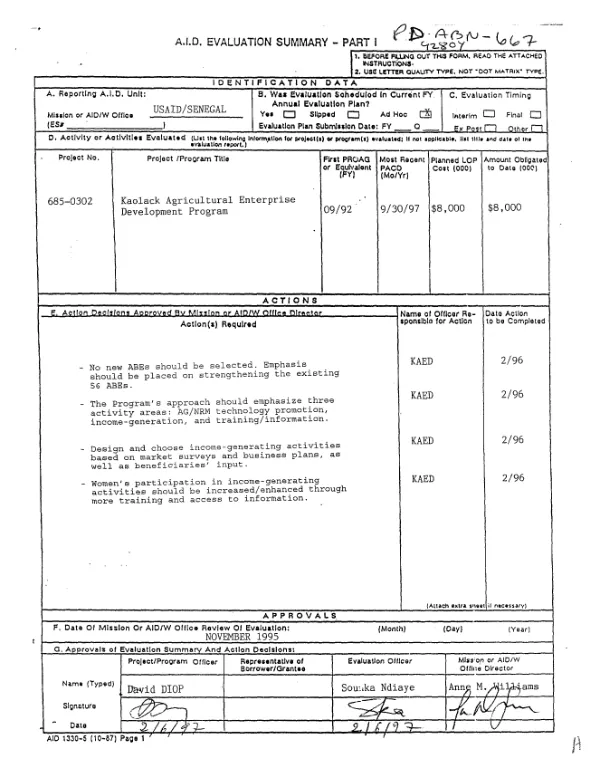
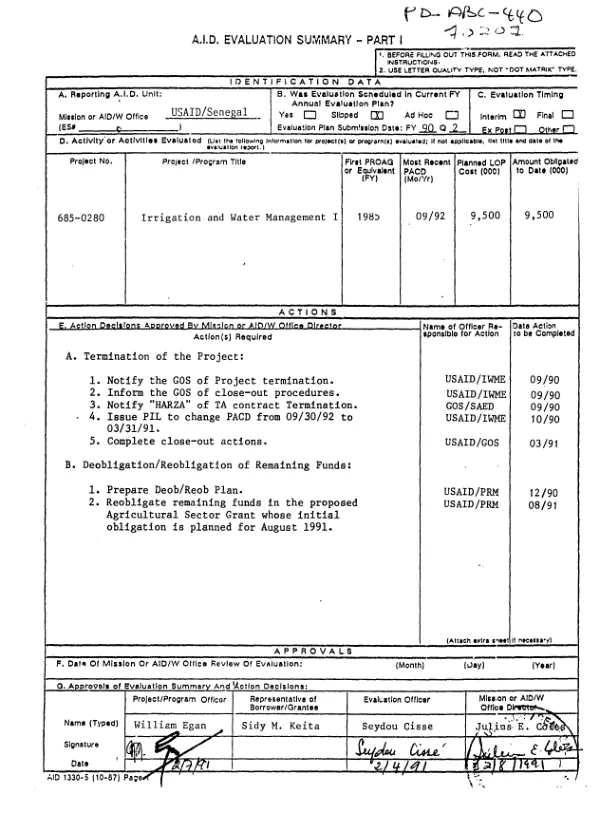
External evaluation covered the period 1985- 6/90. The project has suffered from an unrealistic design. Assumptions regarding crop yields and production costs were off the mark by about 50%; cropping intensity, constrained by lack of marketing outlets, did not increase as projected and is even declining; and the farmers" interest in commercial as opposed to subsistence production was also overestimated. The financial rate of return of the PIV"s for various crop mixes proved negative. Overall, the PIV"s in their present form are neither financially viable nor replicable. A less ambitious program is needed, with lower water application costs and less fertilizer use the first steps toward improving replicability. Despite generally acceptable designs, construction of the PIV"s has been for the most part of poor quality, possibly due to unfulfilled expectations of good work at low wages and to poor onsite supervision. Construction also fell short quantitatively, with only 239 ha built and 50 ha rehabilitated between 1986 and 1988. Given the present cropping system, however, even good construction would not have proven fruitful. Delays were due to many constraints, including a power struggle between the Societe d"Amenagement et d"Exploitation des Terres du Delta (SAED)/Bakel and the HARZA TA team -- stemming from the absence of a clear line of authority, which led to duplication and divergence of effort. HARZA"s approach has been too theoretical (its expertise is not suited to the project), and management of the host country contract by its Chicago office made it difficult to monitor and control expenses, despite the tripartite meetings convened to ensure this goal. As for SAED, its total disengagement from all services except extension and training created a void, given the absence of a viable private sector at Bakel. Additionally, SAED"s policy of expanding construction at all costs conflicted with the views of both USAID/S and HARZA. The socioeconomic monitoring system is one of the project"s few concrete, functioning accomplishments, and should be integrated into SAED for sustainability beyond the project. Also on the positive side are the training program and the demonstration farm. The project has also shown that there is a natural potential for bovine traction in this region, and that onion is a very promising crop. Lessons learned include the following. (1) Design assumptions should be critically evaluated by experts. (2) Large-scale implementation should be preceded by pilot efforts (as was done here). (3) As paddy needs three times as much water as most crops, pumping water is usually too expensive for rice production and should be avoided. As a result of the evaluation, USAID/S and the GOS have agreed to terminate the project; remaining funds will be reobligated to the proposed Agricultural Sector Grant, scheduled to begin 8/91.