USAID DEC
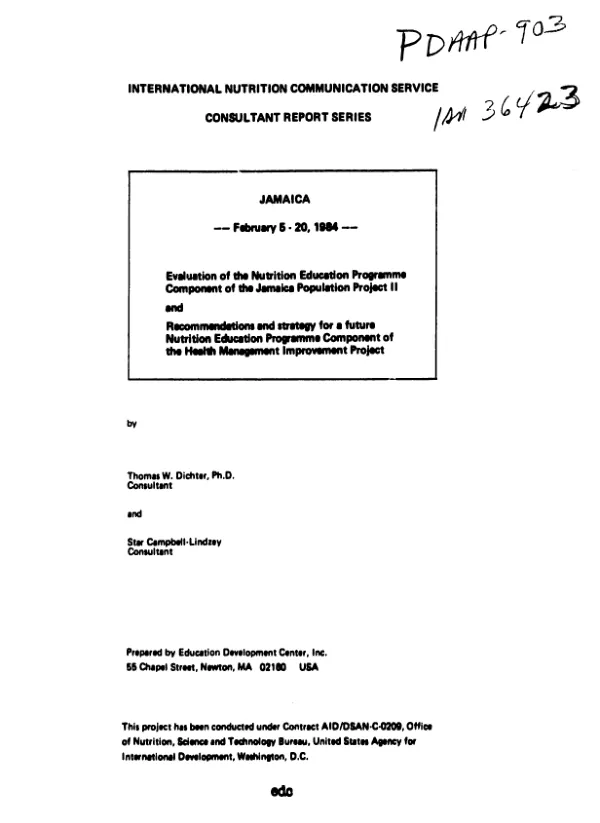
Jamaica, February 5-20, 1984 : evaluation of the Nutrition Education Programme Component of the Jamaica Population Project II and recommendations and strategy for a future Nutrition Education Programme Component of the Health Management Improvement Project
Sign inEDUCATION DEVELOPMENT CENTER, INC. (EDC) INTERNATIONAL NUTRITION COMMUNICATION SERVICE
Jamaica, February 5-20, 1984 : evaluation of the Nutrition Education Programme Component of the Jamaica Population Project II and recommendations and strategy for a future Nutrition Education Programme Component of the Health Management Improvement Project
Evaluates nutrition education component of a population project in Jamaica.
Dichter, Thomas W.|Campbell-Lindzey, Star · 1983
Sign in to readA free account is required to download.
Abstract
Special evaluation (1984) supplements interim evaluation (1980) and is based on review of the media campaign, clinic visits, and interviews with Ministry of Health and USAID/J project personnel, officials from concerned international organizations, and mothers and children. Contrary to what was stated in the 1980 evaluation, the weak effect of the project's media campaign on eating/feeding habits has been mainly due not to unsatisfactory field contact with the target population - community health aides and nutrition assistants were well prepared and supportive of media messages - but to an inadequate understanding of Jamaican food behavior. The baseline social research which supported the project was superficial (in an effort to be broadly based), and later research aimed at determining food-related knowledge, attitude, and beliefs was poorly designed, addressing rational rather more emotional and psychological attitudes and neglecting cultural attitudes (e.g., that only cooked food is food, that a meal must contain meat) and facts (e.g., that Jamaican women crave green fruits during pregnancy, the impact of status and superstition on food choices, the correlation between a mother's ability to provide cooked food and her own sense of adequacy). As a result, message design did not directly address the audience, tending to lecture instead of motivate change. Recommendations are, inter alia, to: conduct an uninterrupted 1-year media campaign on the same issues (breastfeeding, expectant mothers' nutritional needs, anemia, weaning foods, and clinic attendance) but in a more clearly defined way; focus field activities in smaller areas; direct project efforts to those nutritionally most at risk; make media messages reassuring and confidence-building and confine messages largely to radio; rally greater support from hospital staffs, national opinion leaders, the private food industry, and Jamaican research and training institutions; improve training by increasing observational visits to model social marketing programs elsewhere and by conducting workshops to help field personnel develop ways to make mothers more comfortable in participating in the program.
Related documents