USAID. MISSION TO SOMALIA
Juba development analytical studies
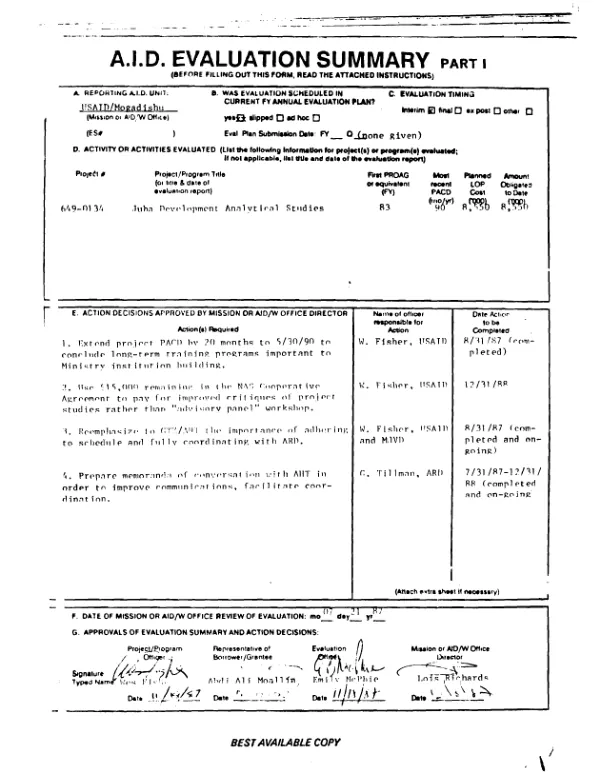
Summarizes attached interim evaluation (XD-AAY-884-A) of a project to help Somalia"s Ministry of Juba Valley Development (MJVD) and its German advisory team prepare a master plan to guide construction of a dam.
1987
Sign in to readA free account is required to download.
Abstract
The evaluation covers the period 9/83-4/87. The project is more or less on track. Classification of soils and land use is 90% completed, and a draft report has been prepared by the U.S. Bureau of Reclamation (one of three TA teams working on the project), although the data should be presented in a more logical way. Identification of environmental and socioeconomic constraints to the dam project is approximately half completed. The contractor for this component, Associates in Rural Development (ARD), has not written a clear workplan, which has resulted in confusion about when and how work is to be accomplished and integrated. This problem is due in part to the failure of German advisors working on the construction plan to clarify their data needs. These problems notwithstanding, research activities in general are progressing well. The institutional development component primarily involves on-the-job and academic training. Under the ARD contract, no MJVD counterpart staff was assigned. As a result, ARD has had to hire and train a large number of Somali staff on its own, which will have no institutional benefits to the MJVD. On the other hand, 8 MJVD staff have been sent to the United States or Kenya for academic training and 15 more are proposed. An action decision extends the project PACD by 20 months to conclude long-term training programs. Several lessons were learned: (1) Qualified and committed counterparts must be made available to a project (2) Donor cooperation and coordination are essential to effective and efficient use of project resources. (3) Research needs and methods must be clearly identified and planned. (4) Use of a PASA mechanism should be very carefully designed and monitored to ensure adequate performance. (5) Technical oversight by the U.S. National Academy of Sciences has not been fully effective due to reliance on volunteers. Paid peer reviewers would probably provide more useful critiques.
![CDA forestry [phase I refugee areas project]](https://covers.devme.ai/gen/72447.webp)