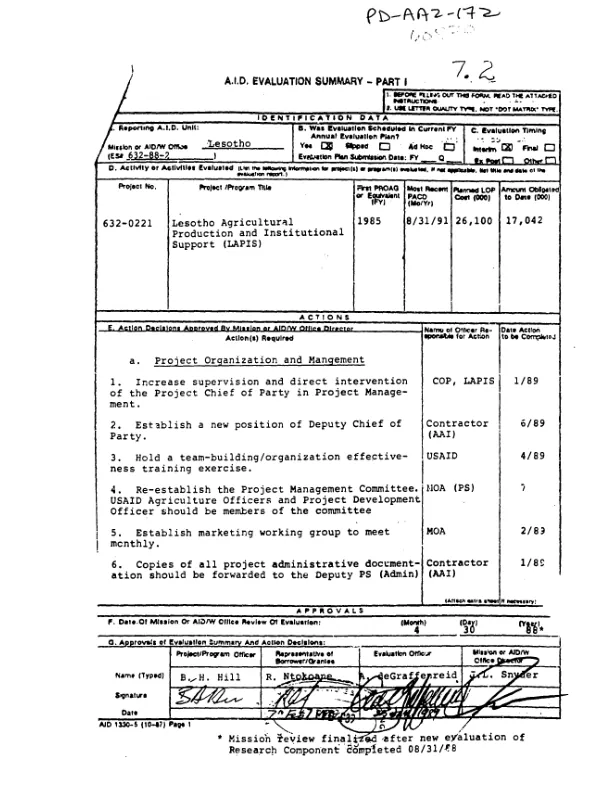
USAID. MISSION TO SOMALIA
Central rangelands development project
Summarizes attached evaluation of a multi-donor project to improve rangelands management practices (RMP"s) in Somalia.
Sharrow, Steven H.; Bryant, David A. +1 more · 1988
Sign in to readA free account is required to download.
Abstract
Interim evaluation covers the period 1979-87 and was based on document review, site visits and observation, and interviews with Mission and project staff. Overall, the project is making a valuable contribution to the educational, scientific, and technological bases for future implementation of improved RMP"s in Somalia, but as an initial project, it should more realistically be viewed as a means of establishing what RMP"s are feasible. Actual infrastructure development and field implementation of technology would then occur in a Phase II. The components assigned to A.I.D. involve developing RMP"s (e.g., sand dune stabilization) and introducing livestock water supply improvements (e.g., boreholes or dugouts); and, providing formal training to National Range Agency (NRA) staff. Regarding the first, the evaluation team notes that it is not aware of any RMP"s for grazing which can be reliably applied to increase range plant or animal production without control of livestock using the range. As livestock numbers control systems are assumed to be socially unacceptable to Somali pastoralists, all proposed interventions should be viewed as experimental until validated by successful implementation in the field. Additionally, water development is not likely to increase plant production; it may increase animal production to the extent that it relieves water stress in livestock and opens up underutilized range areas for grazing. Regarding the NRA, the project has provided effective training opportunities for Somali students but the low pay available to them upon completion of their training and employment with the NRA will more than likely mean a loss of NRA staff over time and a subsequent deterioration in NRA capacities. The major problems affecting this project are the lack of adequate coordination (both among the six participating donors and within the A.I.D. components), unclear chain of command, lack of common agreement on project purpose, and unrealistic objectives, all of which are related to a weak initial project design and the Mission"s reluctance to modify it (this was done only in 1986). Action decisions are to: (1) extend the project two years to establish a sister university relationship as a means of continuing external support to project-trained faculty; (2) waive teaching load restrictions for returned participants; (3) resolve supply problems affecting completion of the forage analysis laboratory; and, (4) hire a resources economist to gather and analyze data on the project"s range improvements. (Author abstract, modified)