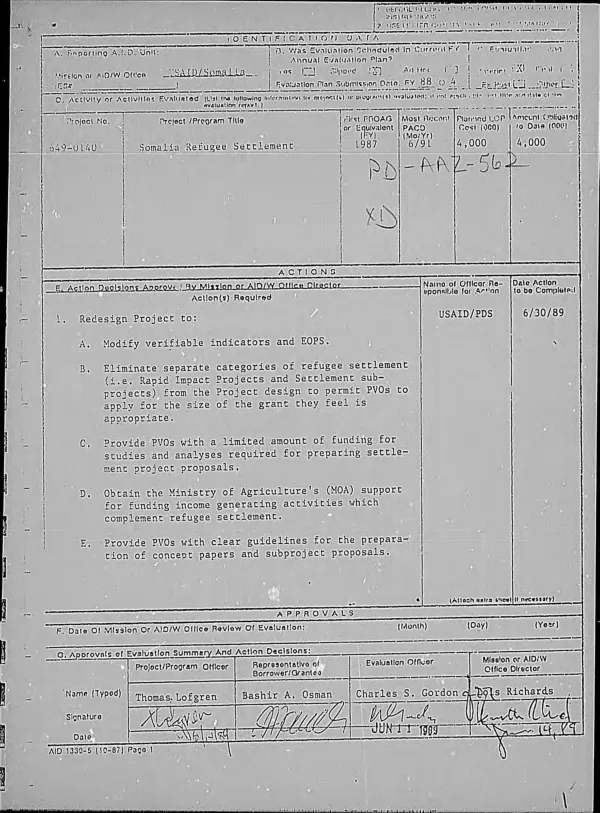
USAID. MISSION TO SOMALIA
Refugee self-reliance
Summarizes attached final evaluation (XD-BBP-367-A) of an experimental project (12/82-3/88) to test strategies and interventions to help refugees in Somalia become more productive and self-reliant.
1988
Sign in to readA free account is required to download.
Abstract
Results were mixed. Some 80% of the A.I.D. project budget was spent on self-reliance subprojects conducted by PVO"s in agriculture, skills training, and infrastructural development. Despite varied levels of success, these subprojects revealed that refugees are willing and able to work and help themselves when given the opportunity and the resources to do so. Achievements included, inter alia: (1) the establishment of new potable water sources; (2) the training of large numbers of refugees in new job skills; (3) the construction and improvement of 240 km of roadway; and (4) the development of 1,235 ha of rainfed land and 320 ha of irrigated area. However, while these short-term activities significantly benefited both refugees and surrounding non-refugee populations, efforts to effect long-term, institutional change were far less successful. Specifically, the provision of staff training and skills upgrading to the National Refugee Commission (NRC) failed to effect significant institutional change - not surprisingly, since project life was too short for this purpose. In other areas, only three of the six socioeconomic/technical studies completed proved useful in identifying possible long-term solutions to the refugee problem; and project monitoring and management suffered from USAID/S"s lack of time and staff and from NRC"s inability to share in this task. The major lesson is that projects designed to address short-term problems should not attempt to simultaneously address longer-term institutional needs. Several other lessons were also learned. (1) Projects which address short-term, volatile situations should have broad and realistic goals, be flexible in implementation, avoid dependence on non-project resources, and frequently evaluate the socioeconomic, technical, and policy issues affecting the project. (2) To avoid delays and conflict, PVO subprojects should rely on one donor only. (3) Labor-intensive road rehabilitation is economically and technically feasible in Somalia. (4) The use of local businesspersons to provide apprenticeship training to refugees is effective. (5) There seems to be a large market for accounting and small business advisory services in rural Somalia. (6) Refugee resettlement is best achieved by focusing on regional development. The Mission notes that the evaluation, as originally received, was unacceptable and had to be heavily edited and in parts rewritten.
![CDA forestry [phase I refugee areas project]](https://covers.devme.ai/gen/72447.webp)

![Project assistance completion report [: refugee self-reliance project 649-0123]](https://covers.devme.ai/gen/9532.webp)