 1989
1989USAID DEC
USAID. MISSION TO TUNISIA
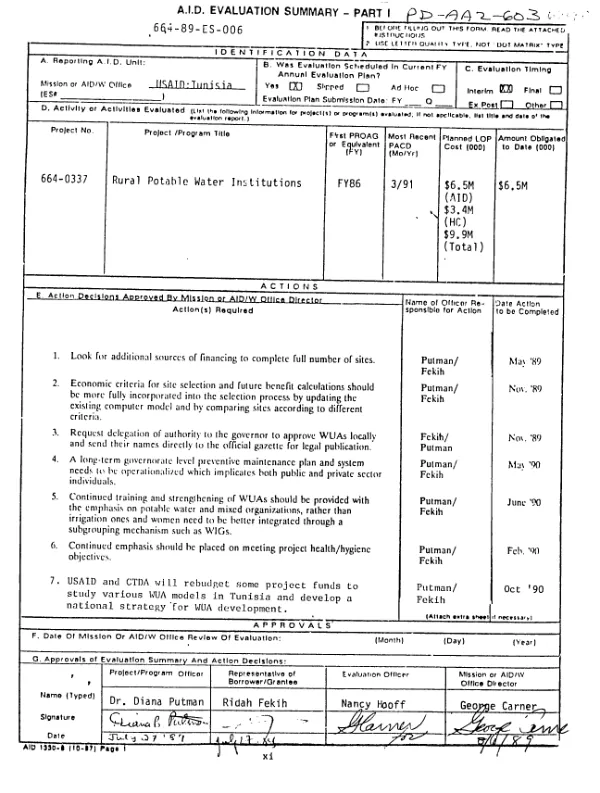
Evaluates project to improve potable water supplies in five delegations of Tunisia"s Kasserine Governorate.
Young, Dorothy; Coppold, Leonard +1 more · 1983
Abstract
PES covers the period 8/79-3/83 and is based on CARE records, survey data, and site visits. The project achieved most revised construction targets: 83 springs and surface wells were improved (10 wells were motorized) and 130 latrines installed at public schools and private homes. Goals for improved health, maintenance, and community participation were met only in part or not at all: the project developed no new water points for rural populations and had limited impact on water quality at handpump sites, engendered minimal beneficiary involvement, and did not overcome handpump maintenance problems (spring and diesel-powered surface well sites are better maintained). CARE trained 100 Ministry of Public Health front line workers, in 6 workshops, to provide health education messages; pre- and post-tests showed that trainees gained an average 10-12% in their understanding of rural health and sanitation issues, but their impact on the beneficiary population is unclear. Also trained were 15 construction crews and two 3-man maintenance teams. Lessons learned are: project sites should have been pared to those where the population desired and was ready to support improvements; handpumps are currently inappropriate for rural, dispersed populations, and motorized systems are valued more highly than handpumps; priority should be given to latrine construction at school sites where health education - which should precede construction - can support the project; CARE should make a greater effort to apply its experience from projects in other countries, should have considered contracting out construction activities (which may have impaired its focus on implementation), and should ensure that its Director is conversant in the local language; promoting "community" participation is difficult where the population is scattered; the quality of water at the delivery point has not been a major concern of the Government or population; and health education provided directly to beneficiaries in tandem with training may have had more impact.
Connected topics
Classification