USAID DEC
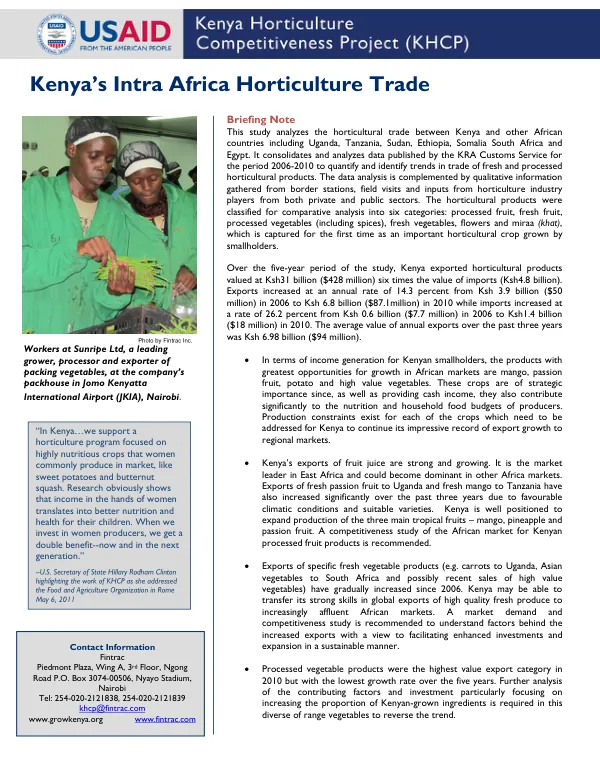
Kenya Horticulture Competitiveness Project (KHCP) Progress Report May 2012
The Kenya Horticulture Competitiveness Project (KHCP) is conducting a long-term study to assess the competitiveness of selected horticultural crops in Kenya.
2012 · 14 pages
Sign in to readA free account is required to download.
Abstract
The study aims to identify comparative and competitive advantages, challenges, and opportunities for specific export and domestic market crops. The analysis includes all aspects of horticultural crop production and supporting infrastructure to identify areas in need of change and propose specific actionable activities to improve the competitiveness of Kenyan-grown produce. Kenyan horticulture has seen unprecedented growth since the early 1980s, with the industry worth over $3 billion a year, one-third of which is from exports. Over 80% of the production of horticultural produce in Kenya is from smallholder farmers, many of whom are not involved in the export business but supply the domestic markets. However, production of vegetables for export is a significant source of income for hundreds of thousands of Kenyan small-scale farmers. Kenya is the most successful producer and exporter of fresh produce and flowers in sub-Saharan Africa, but other countries in Africa and elsewhere offer strong competition that could erode export market share in the future. Ecuador has become a strong competitor in cut flowers, mainly roses, while Egypt challenges Kenya's market share in fine beans and dominates the fast-growing EU market for sweet potato. Ethiopia's horticultural export volumes have increased annually over the past decade, with the main contributor being cut roses. Kenya's Central Bank base lending rates are currently at 18%, relatively high compared to most neighboring and competing countries. However, larger exporters have been able to access hard currency loans at international rates, while small-scale growers can access credit through local banks and micro-financing organizations. In Egypt, smallholders are able to finance crop production through institutional credit, while in Uganda, finance and credit rates are high and pose constant challenges for agribusiness investors. Horticulture is a labour-intensive industry with high demand for unskilled labour, trained supervisors, and professional managers. The daily rates for unskilled labour have tripled over the last 10 years in Kenya, from an average of $1.2 per day in 2001 to more than $3 per day in 2011. Kenya has the highest remuneration of unskilled labour compared to neighboring and competing countries, by almost double. However, general skill and knowledge levels within the Kenyan horticulture sector are higher, and farms in Tanzania and Ethiopia often recruit their key staff from Kenya. Net labour costs reported by Kenyan export companies vary and require further analysis to compare costs and efficiencies of labour relative to other countries. Some larger companies estimate labour to account for 35-45 percent of operating costs, which is high by any standard and a significant determinant of profitability.