USAID DEC
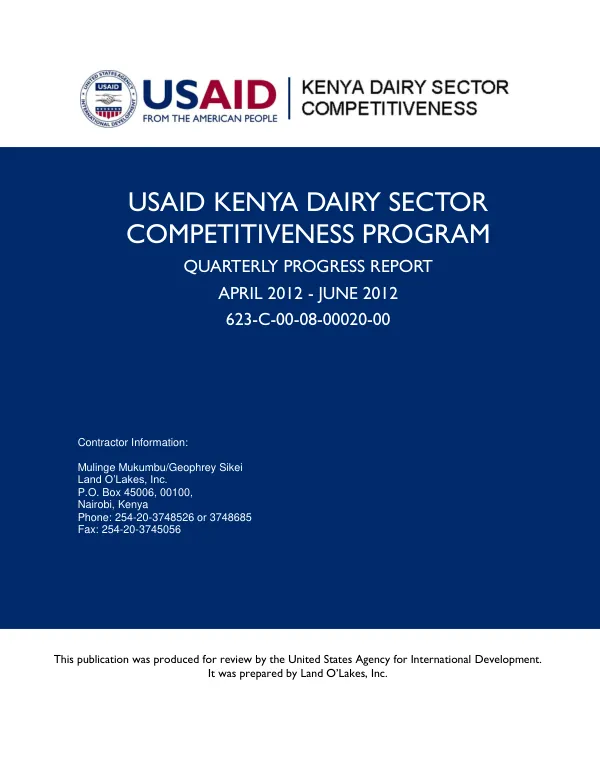
USAID Kenya Dairy Sector Competitiveness Program Quarterly Progress Report April 2012 - June 2012
Sign inLAND O'LAKES INTERNATIONAL
USAID Kenya Dairy Sector Competitiveness Program Quarterly Progress Report April 2012 - June 2012
The Kenya Dairy Sector Competitiveness Program (KDSCP) is a five-year initiative implemented by Land O'Lakes, Inc.
2012 · 28 pages
Sign in to readA free account is required to download.
Abstract
with the financial and technical support of the United States Agency for International Development (USAID). The program aims to improve Kenya's dairy industry competitiveness by transforming the industry into a globally competitive, regional market leader. The overall goal of the program is to increase smallholder household income from the sale of quality milk. The program objectives are three-fold: to increase the competitiveness of the Kenyan dairy sector through collaboration among sector stakeholders and increased capacity of public sector agencies to serve the needs of the sector; to increase marketing of milk meeting quality standards by producer-owned milk bulking/cooling businesses; and to enhance access to market-linked business development services and technologies by male and female dairy farmers and processors producing dairy-related inputs. The program focuses on three key components: Component One, Enhance Capacity for Milk and Production Input Quality Certification and Market Promotion; Component Two, Develop Dairy Smallholder Business Organizations (SBO); and Component Three, Increase Availability of Dairy Business Development Services. The program also addresses environmental degradation mitigation measures and gender and youth intervention. During the reporting period of April to June 2012, the program facilitated milk consumption awareness campaigns in the country, including the launch of the Generic Milk Consumption Campaign. The program also facilitated the attendance of 20 service providers, 24 SBO representatives, and 4 milk shed facilitators to the 8th Eastern and Southern African Dairy Association (ESADA) conference in Nairobi. The program's outreach efforts resulted in the capacity building of 16,049 dairy farmers in the quarter, with a cumulative number of farmers trained to date standing at 129,275. Farmers working with the program have recorded impressive yield figures, with a cumulative average of 9.97 litres/cow/day, indicating a 56% increase relative to the baseline value. The program also recruited and trained 25 new business service providers in the quarter, taking the total number of service providers working with the program to 997. The program continued to implement action plans developed by stakeholders to build capacity of the Smallholder Business Organizations (SBO) and to increase farm level productivity. Cumulatively, 124 farmer organizations have had their capacities built compared to the program target of 120 groups. The program also reported a significant increase in the number of rural households benefiting from the program, with a total of 319,298 households benefiting, surpassing the program target of 300,000 households. Farmers also continued to enjoy financial services from financial service providers, with a total of 7,685 new loan beneficiaries being recorded in this quarter, bringing the total beneficiaries to 58,008, surpassing the program's target of 45,000. The program's performance data indicates a significant increase in the number of farmers trained, the number of service providers, and the number of rural households benefiting from the program. The program's focus on capacity building, business development services, and environmental degradation mitigation measures has contributed to the improvement of the Kenyan dairy industry's competitiveness.