MANAGEMENT SCIENCES FOR HEALTH
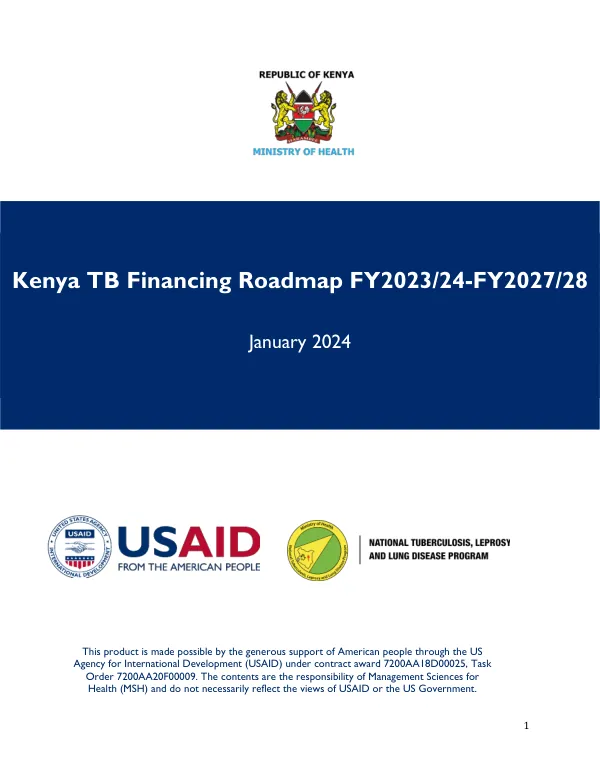
Kenya TB Financing Roadmap FY2023/24-FY2027/28
The Kenya TB Financing Roadmap FY2023/24-FY2027/28 was developed by the National Tuberculosis, Leprosy and Lung Disease Program (NTLD-P) through a consultative process involving the Ministry of Health (MOH), the Universal Health Coverage Technical Working Group (UHCTWG), county government representatives, technical partners, and financial partners.
2024 · 42 pages
Sign in to readA free account is required to download.
Abstract
The situational analysis, strategic initiatives, investment plan, and implementation arrangements for this roadmap were developed through a combination of desk review, one-on-one interviews with key informants, and focus group discussions. The NTLD-P's National Strategic Plan (NSP) 2023/24-2027/28 sets forth a blueprint for overcoming persistent challenges and sustaining progress towards achieving the END TB targets by 2030. To operationalize the NSP, an estimated KES 93.2 billion ($660 million) is required in total over 5 years, but in the NSP's first year, only 17 percent of the total resource requirement has identified financial commitments. Of the $38 million of funding for TB in 2022, one third was from domestic sources. While the true funding gap for the NSP is unknown, there are promising opportunities to mobilize resources towards its strategic interventions from discretionary government budgets, newly introduced social health authority (SHA) funds, earmarks and co-financing arrangements, and the private sector. The objective of the TB Financing Roadmap is to summarize the approaches to be employed to mobilize additional domestic funds towards the NSP 2023/24-2027/28 cost requirement, as well as to capture interventions designed to spend these funds in a more efficient manner with a view to reducing the amount of financial resources needed to implement the NSP. To achieve these objectives, the roadmap sets out the following strategic initiatives and corresponding actions. The first strategic initiative is to mobilize resources from discretionary government budgets. National-level actions include completing the NSP resource mapping exercise for all five years, establishing a Budget Advocacy Task Team within the NTLD-P, and formulating a medium-term advocacy plan. County-level actions include costing county strategic operational frameworks and developing resource mobilization plans, implementing a county-level TB Planning & Budgeting Capacity Building Plan, and formulating and implementing medium-term advocacy plans. The second strategic initiative is to integrate TB services into social protection schemes. This involves ensuring the inclusion of human resource costs for TB diagnosis and clinical care, and activity costs for TB screening and TB public health activities, in the list of services and activities reimbursed by SHA. Monitoring actual and projected revenues for the SHA funds will inform whether the funds should become the domestic financing source for TB drug and diagnostics procurement when donor transition approaches. The third strategic initiative is to ring-fence domestic financing for disease programs including TB via earmarks and co-financing mechanisms. This involves establishing special purpose accounts at the county government level to support transitioning disease programs and introducing and scaling a co-financing arrangement for the county-level special purpose account for transitioning disease programs. The fourth strategic initiative is to supplement government funding for TB with private sector contributions. This involves developing and implementing a plan to engage the private sector in supporting TB control efforts, including through partnerships with private healthcare providers and pharmaceutical companies. The investment plan for the TB Financing Roadmap includes a total of KES 93.2 billion ($660 million) over 5 years, with a breakdown of the funding requirements for each year. The implementation arrangements for the roadmap include the establishment of a project management unit within the NTLD-P, the development of a project monitoring and evaluation plan, and the establishment of a stakeholder engagement plan. The TB Financing Roadmap is a critical document that outlines the approaches and interventions needed to mobilize additional domestic funds towards the NSP 2023/24-2027/28 cost requirement. The roadmap provides a clear roadmap for the implementation of the NSP and sets out the key actions and milestones that need to be achieved in order to achieve the END TB targets by 2030.