USAID DEC
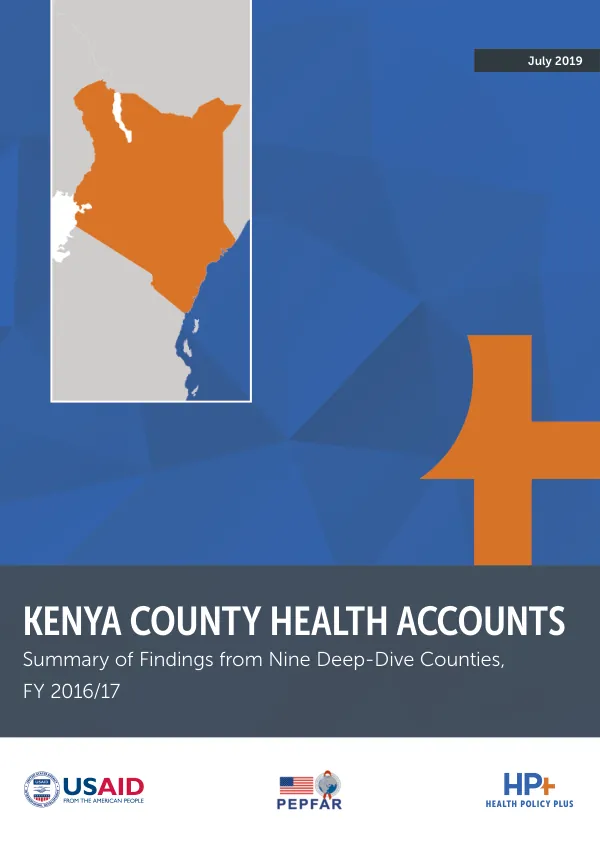
Kenya County Health Accounts: Summary Findings from Nine Deep-Dive Counties, FY2016/17
Sign inAVENIR HEALTH
Kenya County Health Accounts: Summary Findings from Nine Deep-Dive Counties, FY2016/17
The Ministry of Health, in collaboration with the U.S.
2019 · 24 pages
Sign in to readA free account is required to download.
Abstract
Agency for International Development (USAID)-funded Health Policy Plus project, supported nine deep-dive counties in Kenya to update their county health accounts (CHA) to inform policies, planning, and budgeting. These counties received enhanced technical assistance from Health Policy Plus, which included additional evidence generation activities such as public expenditure analysis, CHA, and regular tracking and monitoring of selected health financing indicators. The nine deep-dive counties were selected because they have a high concentration of USAID implementing partners and the enhanced support could generate synergies with other implementing partner support to these counties. CHA is a resource tracking tool that adopts the National Health Accounts methodology to estimate total health expenditure (THE), track the flow of expenditures through the health system, and link funding sources to service providers and use of funds by functions/services in the county. Using CHA outputs, policymakers can make evidence-based decisions about financing and resource allocation. On average, the nine deep-dive counties spent over 26 percent on health relative to total county government expenditure (TCGE) in FY 2016/17. Nakuru County spent the highest government expenditure on health as a proportion of TCGE at 54.2 percent in FY 2016/17, an increase from 32.8 percent the previous year. Mombasa, Nyeri, and Turkana registered a decline in the proportion of TCGE going to health from their FY 2014/15 values, with Mombasa having the biggest reduction—from 21.4 percent in FY 2014/15 to 13 percent in FY 2016/17. The deep-dive counties jointly mobilized a total of KSh 68.6 billion from four main sources—households, governments, private firms, and donors—during the FY 2016/17. On average, governments provided the most funds for healthcare in seven of the counties, followed by households in six out of the nine counties. Government and households accounted for 44 and 29 percent, respectively, of THE in FY 2016/17. Kilifi, Kitui, and Nakuru counties had the highest proportion of government contribution to health at 59, 56, and 63 percent, respectively. Nyeri and Turkana counties had the highest proportions of their THEs funded by contributions from households at 41 and 49 percent, respectively. Private firms contributed significantly to healthcare expenditure funds in Mombasa (14 percent) and Nyeri (13 percent), while donors formed a sizable contribution in Busia (23 percent), Migori (24 percent), and Turkana (31 percent). In the nine deep-dive counties, households, county health departments, and nongovernmental organizations managed over 82 percent of the health funds in FY 2016/17. County health departments in the nine counties controlled, on average, 46 percent of THE, compared to 27 and 10 percent controlled by households and nongovernmental organizations, respectively. The county health accounts (CHA) tool comprehensively examines financial flows and health expenditures in the counties, including what sources fund health, who manages the health funds, where funds are spent, and how much is spent on specific health services/functions. This report provides a synthesis of the findings of the fiscal year (FY) 2016/17 CHA study of nine deep-dive counties and compares the findings with the FY 2014/15 and FY 2015/16 baseline years.
Related documents