ACDI/VOCA
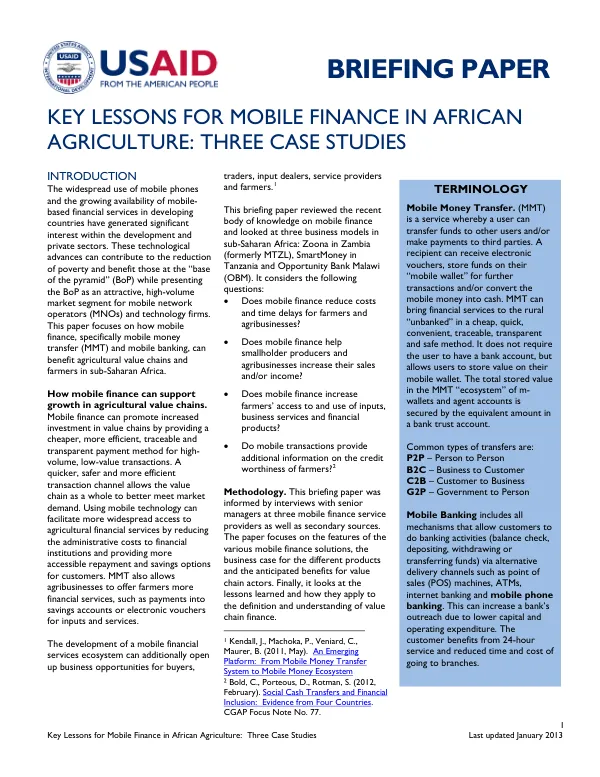
Key Lessons for Mobile Finance in African Agriculture: Three Case Studies
Mobile finance has the potential to significantly benefit agricultural value chains and farmers in sub-Saharan Africa by providing a cheaper, more efficient, and transparent payment method for high-volume, low-value transactions.
2013 · 6 pages
Sign in to readA free account is required to download.
Abstract
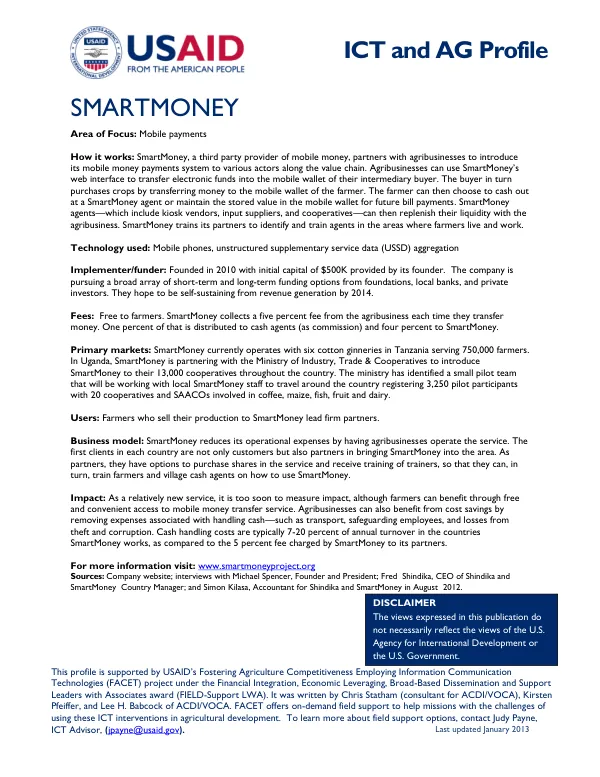
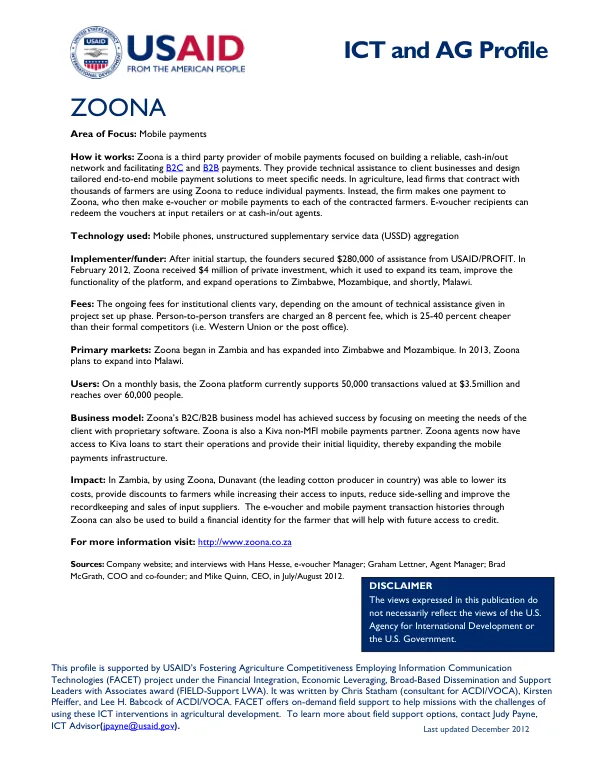
This can facilitate increased investment in value chains by reducing administrative costs to financial institutions and providing more accessible repayment and savings options for customers. Mobile money transfer (MMT) and mobile banking can also enable agribusinesses to offer farmers more financial services, such as payments into savings accounts or electronic vouchers for inputs and services. The development of a mobile financial services ecosystem can open up business opportunities for buyers, traders, input dealers, service providers, and farmers. A case study of Zoona in Zambia, formerly MTZL, found that the implementation of mobile finance reduced costs and time delays for farmers and agribusinesses. The use of mobile money transfer enabled farmers to receive payments more quickly and efficiently, reducing the need for cash transactions and associated risks. In Tanzania, SmartMoney implemented a mobile banking system that allowed customers to conduct banking activities, such as balance checks and transactions, via mobile phone. This increased the bank's outreach and reduced the time and cost associated with visiting branches. The system also provided customers with 24-hour service and improved data management. Opportunity Bank Malawi (OBM) implemented a mobile banking system that enabled customers to conduct transactions and access financial services via mobile phone. The system reduced the time and cost associated with visiting branches and provided customers with 24-hour service. OBM also reported an increase in customer adoption and usage of mobile banking services. The MNO-led MMT model, exemplified by Vodafone's M-PESA in Kenya and Tanzania, has been successful in providing financial services to the rural poor. However, this model has limitations, including a lack of focus on agricultural value chains. An alternative model, the third-party provider model, focuses on B2C payments within existing ecosystems and provides change management technical assistance to client businesses and organizations. The third-party provider model offers several benefits to agribusinesses, including reduced cash-handling costs, risk, and fraud; a more transparent and traceable audit trail; reduction in capital and operating expenditure; increased outreach and field officer efficiencies; and quicker and more accurate management reports. This model can be particularly beneficial for agribusinesses that require technical assistance to transition their payments from cash to mobile money transfer. Overall, mobile finance has the potential to significantly benefit agricultural value chains and farmers in sub-Saharan Africa by providing a cheaper, more efficient, and transparent payment method. The development of a mobile financial services ecosystem can open up business opportunities for various stakeholders, and the third-party provider model offers several benefits to agribusinesses.
Related documents