USAID DEC
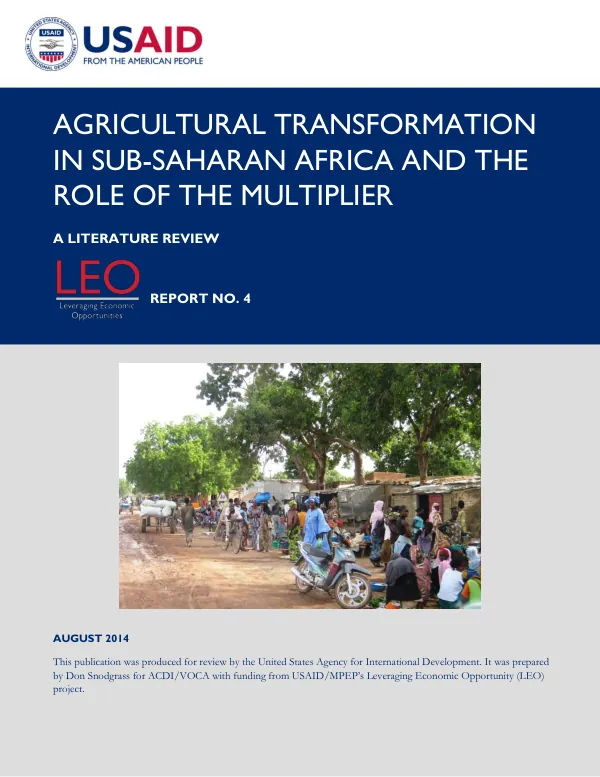
Agricultural Transformation in Sub-Saharan Africa and the Role of the Multiplier: A Literature Review
Sign inACDI/VOCA
Agricultural Transformation in Sub-Saharan Africa and the Role of the Multiplier: A Literature Review
Agricultural transformation in Sub-Saharan Africa and the role of the multiplier is a critical issue in the coming decades.
2014 · 47 pages
Sign in to readA free account is required to download.
Abstract
Rapid population growth and slow agricultural productivity growth could lead to a major humanitarian crisis, with large increases in the working-age population and daunting problems of food supply, poverty, and underemployment. Lowered population growth, job creation, and higher agricultural productivity are needed to avert this impending disaster. Projections of food demand and supply for Africa are daunting. Demand for food is expected to rise by 2.9% a year from now to 2050, largely as a result of population growth that could expand the continent's population from 1.1 billion today to 2.4 billion by 2050. Yet productivity growth in agriculture averaged only 1% a year from 2001 to 2010. If that growth rate were to persist until 2050, Africa would be able to meet only 25% of its total food demand in that year. Greatly reduced fertility and much faster growth in agricultural productivity are both needed. Economic growth has resumed in the past 20 years in many SSA countries, and several positive signs of change have emerged. However, the kind of far-reaching economic transformation that accompanied long-term economic development in other world regions is not yet apparent. To avert catastrophe over the coming decades, SSA must undergo radical economic transformation. Its economic future must be very different from its past. At the macro-economic level, the relative importance of the agricultural sector in both GDP and employment must decline sharply while the corresponding shares of manufacturing, construction, and high-value services rise. Agriculture must grow to feed the rising population, earn foreign exchange, supply labor to expand employment in the industrial and service sectors, and provide a market for growing manufacturing output. To do all these things, the sector itself must be transformed. Agricultural technology must be modernized, commercialization increased, and non-agricultural rural activities made more productive so that they can provide a rising share of income for rural households. In low-income countries, such as most of those in Sub-Saharan Africa, development can be described as agriculture-based. Agriculture's contributions to development are enhanced by the multiplier effect. Studies using varied methodologies have placed the average value of the multiplier in SSA around 1.5. That is, a $1 increase in agricultural income—brought on, say, by an investment or technological change—can raise national (or in some studies, non-farm rural) income by $1.50. The multiplier has three components: an initial stimulus to income growth, a transmission mechanism, and a final impact. In the setting of SSA, possible initiating stimuli include technological change and investment, including infrastructural investment, private investment, and investment in human capital. Transmission works through several demand and supply mechanisms that are described in this paper. In terms of impact, while some aspects of the demand-side mechanism may weaken as countries develop, others will remain and supply-side mechanisms involving linkages and spillovers will still be important. The multiplier effect can help raise income levels in rural SSA and strengthen the "pull" effect on rural non-agricultural enterprise. The existence of the multiplier effect strengthens the case for investing in agriculture and removing any remaining urban bias in government policies. It is essential to realize, however, that much of the multiplier's power depends on boosting demand for locally produced products and services that are non-tradable—either inherently (like construction and many services) or effectively (like basic foodstuffs because of high transportation and marketing costs). As markets broaden and trade with other regions and countries becomes easier, the demand-side mechanism driving the multiplier effect may weaken. Even so, the potential for positive externalities will remain. In the longer run, attention to linkages and spillovers is likely to be the most important policy implication of the multiplier effect. This requires improvements in features of the commercial environment for agriculture such as better communications, improved ways of doing business, and heightened trust among participants in commercial transactions. It also requires strengthened linkages between farmers and global value chains, as well as domestic and foreign investors. The concept of the multiplier originated in economics and is defined as "any measure of the proportional effect of an exogenous variable on an endogenous variable." The fiscal multiplier is a term that measures how much aggregate demand changes in response to a change in spending. The multiplier effect is a critical concept in understanding the relationship between agricultural development and national economic development and poverty alleviation in SSA. Studies have derived measures of the multiplier in African agriculture, and the factors that affect its magnitude have been identified. The multiplier has been found to be around 1.5 in SSA, indicating that a $1 increase in agricultural income can raise national income by $1.50. The multiplier effect can help raise income levels in rural SSA and strengthen the "pull" effect on rural non-agricultural enterprise. The implications of the multiplier effect for the development of agriculture, the rural economy in general, and the national economies of SSA in their current circumstances are significant.
Related documents