IOM
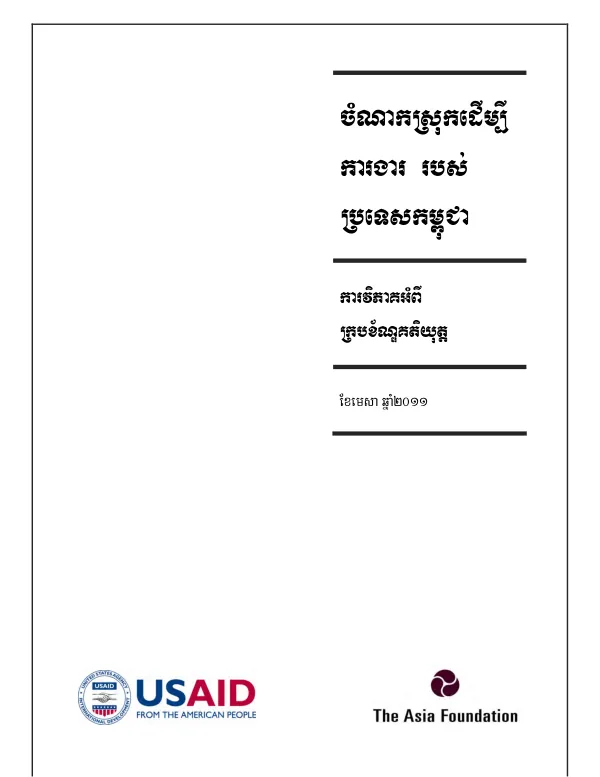
Khmer version - Cambodia's Labor Migration: Analysis of the Legal Framework
The Global Alliance Against Traffic in Persons (GAATIP) was launched in 2011 by the United Nations Inter-Agency Project on Human Trafficking (UNIAP) in collaboration with the United Nations Office on Drugs and Crime (UNODC).
2011 · 86 pages
Sign in to readA free account is required to download.
Abstract
The initiative aimed to strengthen national and regional efforts to combat human trafficking, particularly in the Asia-Pacific region. The GAATIP framework emphasized the importance of a comprehensive approach to combating human trafficking, involving governments, civil society organizations, and the private sector. The initiative focused on several key areas, including prevention, protection, prosecution, and partnership. Prevention efforts involved raising awareness about human trafficking and its consequences, as well as promoting education and economic opportunities for vulnerable populations. Protection measures included providing support services to victims of human trafficking, such as shelter, counseling, and medical care. Prosecution efforts focused on strengthening laws and law enforcement capacities to investigate and prosecute human trafficking cases. Partnership-building was also a key component of the GAATIP, with a focus on collaboration between governments, civil society organizations, and the private sector to share best practices and resources. The GAATIP framework also recognized the importance of addressing the root causes of human trafficking, such as poverty, inequality, and social exclusion. It emphasized the need for a holistic approach that addresses the social, economic, and cultural factors that contribute to human trafficking. The initiative was supported by a range of international organizations, including the United Nations Development Programme (UNDP), the International Labour Organization (ILO), and the World Health Organization (WHO). It also received support from regional organizations, such as the Association of Southeast Asian Nations (ASEAN), and national governments in the Asia-Pacific region. The GAATIP framework was developed through a consultative process involving governments, civil society organizations, and other stakeholders. It was launched at a high-level meeting in Bangkok, Thailand, in 2011, and was endorsed by the United Nations General Assembly in 2012. The GAATIP has been implemented in several countries in the Asia-Pacific region, including Cambodia, Indonesia, Malaysia, the Philippines, and Thailand. It has also been used as a model for other regional and national initiatives to combat human trafficking. The GAATIP framework has been recognized as a key tool for combating human trafficking, and has been endorsed by a range of international organizations and governments. It continues to be implemented and adapted in various countries and regions, and remains an important component of efforts to combat human trafficking globally. The GAATIP has also been recognized for its emphasis on the importance of addressing the root causes of human trafficking, such as poverty, inequality, and social exclusion. It has been praised for its comprehensive approach to combating human trafficking, which involves prevention, protection, prosecution, and partnership. The GAATIP has also been recognized for its focus on the importance of addressing the social, economic, and cultural factors that contribute to human trafficking. It has been praised for its emphasis on the need for a holistic approach that addresses the root causes of human trafficking. The GAATIP has also been recognized for its launch at a high-level meeting in Bangkok, Thailand, in 2011, and its endorsement by the United Nations General Assembly in 2012. It has been praised for its comprehensive approach to combating human trafficking, which involves prevention, protection, prosecution, and partnership. The GAATIP has also been recognized for its launch at a high-level meeting in Bangkok, Thailand, in 2011, and its endorsement by the United Nations General Assembly in 2012. It has