MERCY CORPS INTERNATIONAL
Lafia: Quarterly Report, Oct-Dec. 2020
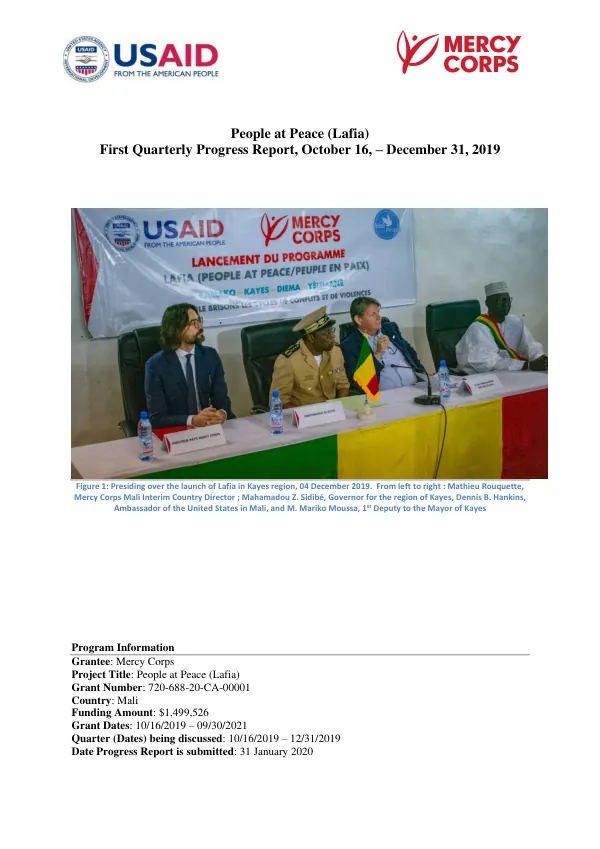
The Lafia program, implemented by Mercy Corps and Think Peace, aims to increase resilience to conflict and violent extremism in southern and western Mali.
2020 · 20 pages
Sign in to readA free account is required to download.
Abstract
The program focuses on three interlinked objectives: reducing youth vulnerability to participating in conflict and violent extremism, resolving inter-group conflicts peacefully, and engaging local communities with government authorities and civil society actors in preventing violent extremism and promoting reconciliation. Youth associations have conducted a mapping exercise on vulnerability to violence and sources of resilience, which has been completed in the second quarter. Additionally, 80 Sport for Change (S4C) Clubs have been set up to involve 2,000 youth at risk of participation in conflict in identification and resolution of conflict in collaboration with youth leaders. The program has also provided training of coaches on the Sport for Change modules and regular technical support to the implementing partner Think Peace to ensure effective and efficient implementation of activities. The socio-political situation in Mali remains fragile due to unrest and the actions of the military on August 18, 2020, culminating in the forced resignation of President Keïta and political instability. Mali continues to navigate the consequential political transition and institutional crisis. The long-term lack of economic opportunity, exacerbated by the impacts of COVID-19, mistrust between the people and the government, land expropriations, and socio-cultural considerations that hinder equitable access to basic social services are all factors that amplify existing tensions. In Kayes region, several incidents related to the ongoing presence of slavery have been recorded. On October 15, 2020, a gathering of victims of slavery in front of Bafoulabe court (Kayes region) took place, followed by demonstrations on October 20, 2020, demanding justice for the victims and the passing of a law incriminating this practice. The gathering was peaceful, but the demonstrators were subjected to violence upon their return to their respective localities. In total, about twenty incidents related to slavery were recorded in 2020. The Lafia team has successfully adapted the program schedule and activities to address the challenges posed by the COVID-19 pandemic and Mali's socio-political crisis. Despite several delays, implementation continues to progress smoothly. The program has made progress in building the capacity of youth and leaders on various themes, including the training of coaches on the Sport for Change modules and regular technical support to the implementing partner Think Peace. The program has also made progress in reducing youth vulnerability to participating in conflict and violent extremism. The implementation of Activity 1.1, a mapping exercise on vulnerability to violence and sources of resilience, has been completed. Additionally, 80 Sport for Change (S4C) Clubs have been set up to involve 2,000 youth at risk of participation in conflict in identification and resolution of conflict in collaboration with youth leaders. The Lafia program continues to face challenges, including the ongoing presence of slavery in Kayes region and the socio-political crisis in Mali. However, the program has made progress in building the capacity of youth and leaders on various themes and reducing youth vulnerability to participating in conflict and violent extremism. The program will continue to adapt to the changing context and work towards its objectives of increasing resilience to conflict and violent extremism in southern and western Mali.