USAID DEC
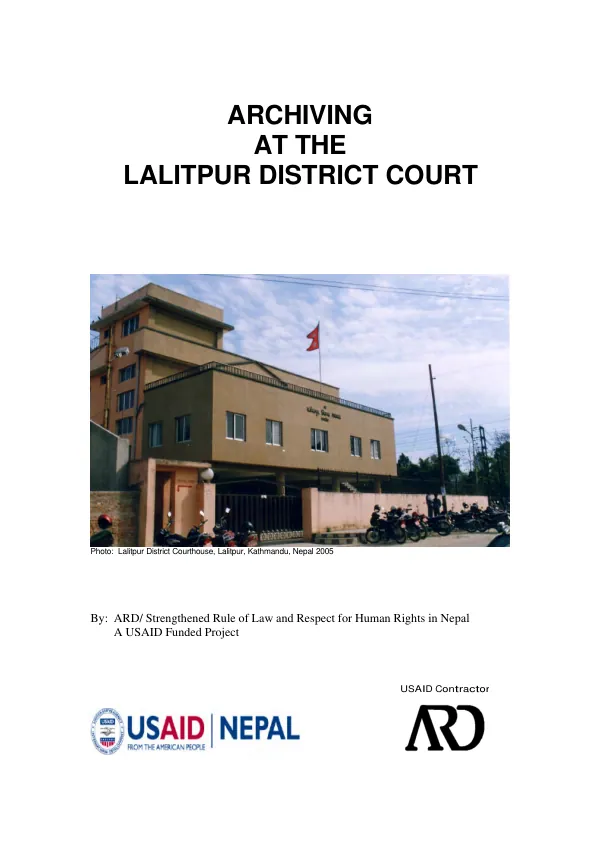
LALITPUR COURT ARCHIVES
The Lalitpur District Court in Nepal has approximately 50,000 case files in its archives.
5 pages
Sign in to readA free account is required to download.
Abstract
The archive room is overwhelmed with documents, with case files held together with string and shelved on metal shelves. Multiple case files are filed in cotton sacks, which are often left on the floor. All files are kept indefinitely on-site, with no fire safety measures in place. Some archived files are more than 100 years old, and many are in poor condition, with missing or damaged documents, faded ink, or indelible writing. Locating and retrieving an archive file can be a problem, and file retrieval has sometimes been a source of corruption, with court staff unable to find a particular file until they are encouraged to do so by a small contribution. In summary, the Lalitpur Court archives can be described as inefficient and chaotic. A consultant from the ARD Rule of Law project worked with the courts to develop a plan for organizing the archive files. The plan included on-the-job training in archiving and document retrieval, cleaning and screening of documents according to a maturity schedule, preparing brief notes of case files more than 12 years old, destroying files and documents that meet retention guidelines, boxing and shelving case files required to be retained, and developing a computerized file retrieval system. ARD provided financial support for the project, including the purchase of file storage boxes and shelving. Due to the large number of files and staff workload, the staff worked on weekdays, holidays, and before and after court hours to complete the training and clearing and organizing of the archive files. As a result of the ARD/USAID supported activities, 33% of the archived files were destroyed as allowed by retention requirements, 28,000 case files were repaired, boxed, and shelved, and 2,000 files of supporting documents were returned to the government agencies from which they had been borrowed. The automated file retrieval system has been installed at the Court, and the staff is entering the data showing location, etc. The room is now organized, with files boxed and stored on metal shelves, and there is space for additional files. The atmosphere reflects professionalism, and the court's archives are now more efficient and accessible.
Related documents