USAID
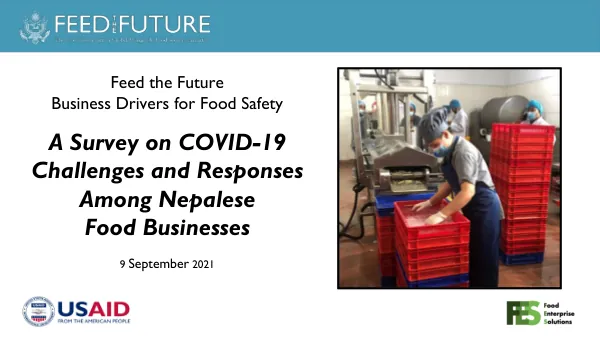
COVID-19 Challenges Among Nepalese Food Businesses
Agricultural development initiatives in Nepal faced significant challenges due to the COVID-19 pandemic.
2021 · 23 pages
Sign in to readA free account is required to download.
Abstract
The pandemic led to widespread cessation of economic activities, with small and medium-sized enterprises (SMEs) and associated workers, particularly the poor, being disproportionately affected. Market closures, supply chain disruptions, and reduced demand resulted in a significant decline in sales and revenue for food businesses. A study by the Nepal Rastra Bank found that the recovery in this sector is one of the slowest, currently operating at only 41 percent of pre-lockdown level. A rapid survey of the COVID-19 impacts on food businesses was conducted by the BD4FS to understand the extent of the pandemic's impact on key business parameters such as demand, sales, and costs. The survey consulted 61 food business owners/operators, including wholesalers, retailers, processors, exporters, and e-commerce businesses, in the Kathmandu and Chitwan corridors of Bagmati Province. The survey found that more than 69% of the food businesses experienced a decrease in demand, while 82% observed a decrease in sales. The price of raw materials remained constant for 41% of the food businesses, while 39% reported an increase in prices. The survey also revealed that the COVID-19 pandemic had a significant impact on the supply chain of food businesses. The lockdown and prohibitory orders led to a decline in the availability of raw materials, resulting in a shortage of essential commodities such as fruits and vegetables, eggs, and meat. The pandemic also led to a significant increase in overhead costs for food businesses, with 82% of the respondents reporting an increase in costs. The survey found that the food businesses were forced to scale back their production and seek new distribution channels to cope with the decline in sales. The survey also highlighted the challenges faced by food businesses in terms of human resources and finances. The lockdown and prohibitory orders led to a significant decline in the availability of labor, resulting in a shortage of skilled workers. The pandemic also led to a significant decline in the availability of finances, resulting in a shortage of working capital for food businesses. The survey found that 30% of the food businesses scaled back their production, while 20% sought new distribution channels, 18% formed new partnerships, and 13% used new ways of advertisement. The COVID-19 pandemic had a significant impact on the food business sector in Nepal, resulting in a decline in sales, revenue, and revenue growth. The pandemic also led to a significant increase in overhead costs, a shortage of raw materials, and a decline in the availability of labor and finances. The survey found that the food businesses were forced to scale back their production, seek new distribution channels, and adopt new ways of advertisement to cope with the decline in sales. The pandemic also led to a significant decline in the availability of institutional buyers, resulting in a decline in sales for food businesses.