USAID DEC
Lanzamiento de proyecto regional para reducir el riesgo de terremotos mediante la coordinación interdepartamental y público-privada
Sign inMIYAMOTO INTERNATIONAL, INC.
Lanzamiento de proyecto regional para reducir el riesgo de terremotos mediante la coordinación interdepartamental y público-privada
The regional project for reducing earthquake risk through interdepartmental and public-private coordination was launched on September 30, 2020, for a period of two years in the Eje Cafetero region of Colombia.
2020 · 2 pages
Sign in to readA free account is required to download.
Abstract
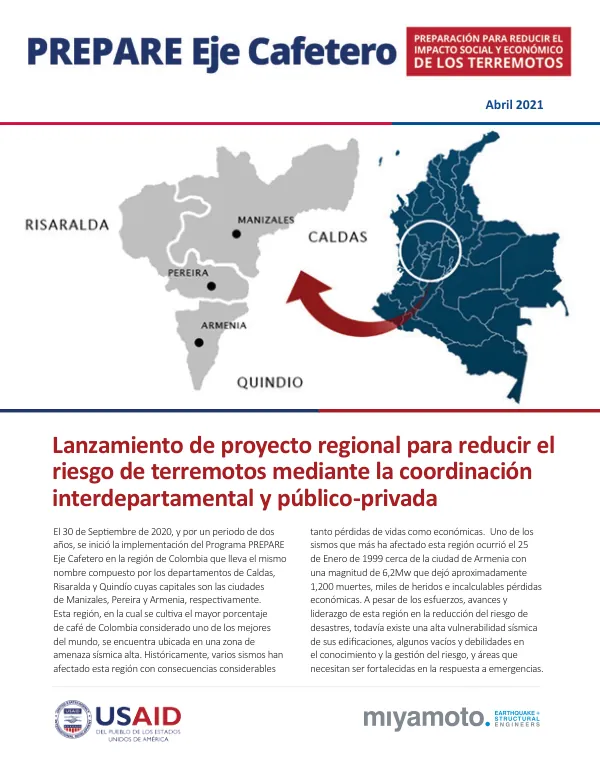
This region, composed of the departments of Caldas, Risaralda, and Quindío, is located in an area of high seismic risk. The region is known for producing a significant portion of Colombia's coffee, considered to be among the best in the world. Historically, several earthquakes have affected this region, resulting in significant losses of life and economic damage. One of the most devastating earthquakes occurred on January 25, 1999, near the city of Armenia, with a magnitude of 6.2Mw, resulting in approximately 1,200 deaths, thousands of injuries, and incalculable economic losses. The region has made efforts to reduce disaster risk, but it still faces high seismic vulnerability due to inadequate building codes, knowledge gaps, and weaknesses in emergency response. The Program PREPARE Eje Cafetero aims to strengthen the regional capacity for risk management and emergency response. The program's objectives include improving knowledge of risk and its availability in the region, enhancing communication of seismic risk and its adoption by authorities and decision-makers, strengthening urban search and rescue (USAR) groups and other rescue teams, and facilitating regional cooperation on these issues. The program is the first regional implementation of the PREPARE program, targeting a population of approximately 2,400,000 people. The program is led by three departmental governments and three municipal governments, including their risk management offices and other entities, as well as eleven USAR teams, eleven public and private universities, private sector companies, and national institutions such as the National Unit for Disaster Risk Management (UNGRD) and the Colombian Geological Survey (SGC). Six memorandums of understanding have been signed with the departmental and municipal governments, and additional agreements are expected to be signed with universities and national institutions in the coming weeks. The program's early stages have achieved significant progress, including the articulation and coordinated work between government entities responsible for risk management, emergency groups, and academia, as well as their commitment to continue improving their processes for knowledge and corrective and prospective intervention in risk management and emergency response. This regional approach aims to support a coordinated and collaborative effort to reduce earthquake risk in the Eje Cafetero region.