USAID
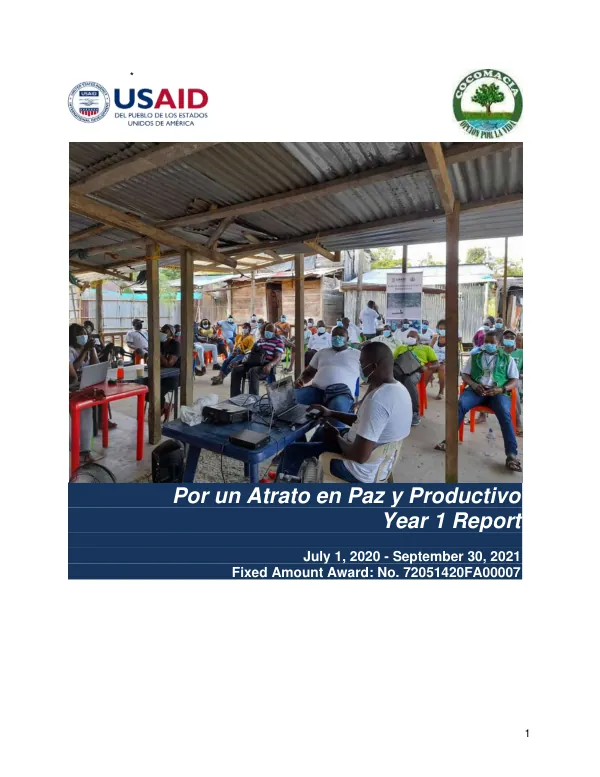
Por un Atrato en Paz y Productivo Year 1 Report
The program "Por un Atrato en Paz y Productivo" was implemented by COCOMACIA in the departments of Chocó and Antioquia, Colombia, with the goal of improving the organization's capacity for governance, administration of the territory, and inter-institutional dialogue.
2020 · 49 pages
Sign in to readA free account is required to download.
Abstract
The program was funded by the United States Agency for International Development (USAID) through a fixed amount award. The program's main objective was to improve COCOMACIA's capacity for planning, incidence, and articulation with local and regional institutional plans, as well as to update and harmonize the organization's planning instruments. To achieve this, COCOMACIA conducted sessions with its technical and legal teams, as well as participatory meetings with representatives from local community councils (CCL). These instruments will facilitate the organization's planning and project execution capabilities at different levels. The program also focused on strengthening COCOMACIA's capacity for administrative and financial management, with the goal of ensuring its sustainability. This was achieved through the development of a plan to improve the tools used by COCOMACIA in implementing new policies, procedures, and updating its manual of functions, led by the Program for Inclusion in Peace (IPA) cofinanced by the International Organization for Migration (OIM). In addition, COCOMACIA improved its capacity for territorial control, governance, and articulation with its area of influence, through the updating, socialization, and application of internal regulations with a gender perspective. The organization's communication and accountability capacity was also strengthened through the empowerment of COCOMACIA STEREO, the organization's main communication medium. The program also aimed to improve COCOMACIA's capacity for interlocution and incidence with national and territorial institutions, particularly in relation to the implementation of the Peace Agreement and the Ethnic Chapter. In the first year, the program's team conducted training processes for the first 250 people (women, men, and young people) from different COCOMACIA instances, creating capacities for interlocution and incidence with institutions regarding the Peace Agreement and the Ethnic Chapter. The current situation in the eight municipalities that make up COCOMACIA's area of influence is characterized by severe problems, as communities feel stigmatized, intimidated, and unable to exercise their traditional practices of production freely due to the current state of public order in the territories. The COVID-19 pandemic, humanitarian crisis, and winter wave that affected Acacian families in the territory have exacerbated these problems. The pandemic has led to a new exponential phase of contagions, with a total of 16,364 cases and 391 deaths in the Department of Chocó as of September 28, 2021. The health service deficit and the collapse of ICU beds, 34 in total for the entire Department, have created a situation of concern. In response to this situation, ethnic authorities have made enormous efforts to strengthen traditional medicine and articulate it with Western medicine as a prevention and protection mechanism against the pandemic. The humanitarian crisis in the territories has been exacerbated by the reconfiguration of the armed conflict after the signing of the peace agreement between the Government and the FARC EP guerrilla. The dispute for territorial control and the reorganization of legal and illegal armed actors have intensified human rights violations and customary international humanitarian law, resulting in communities being confined, displaced, assassinated, threatened, and the use and recruitment of child and adolescent soldiers, as well as the increase in the cultivation of illicit crops in most of the titled territory. This panorama is likely to continue due to the lack of guarantees and the absence of a willingness to address the situation from the government, which has responded with militarization of the territories, which also poses a risk to the communities.