USAID DEC
Leadership in Financial Management: Uganda’s Tax System
Leadership in public financial management in Uganda is a critical area of focus, particularly in the context of the country's tax system.
2015 · 5 pages
Sign in to readA free account is required to download.
Abstract
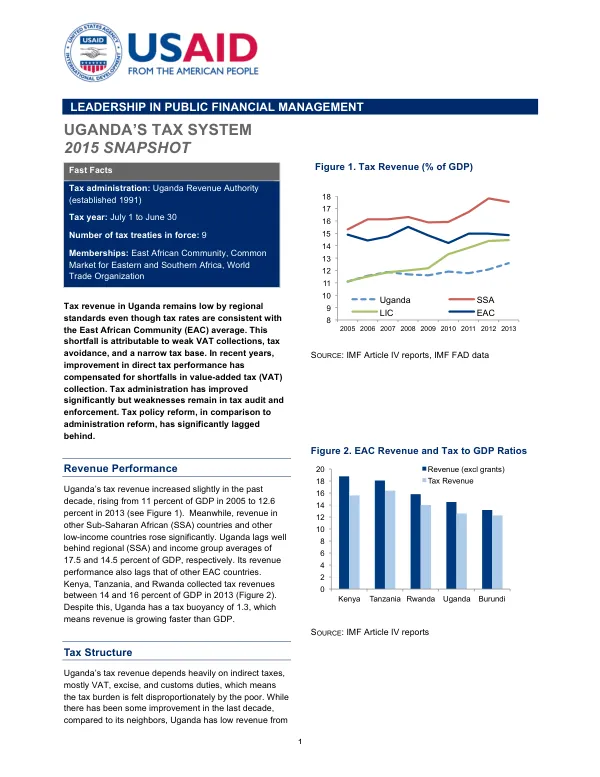
The Uganda Revenue Authority (URA) is responsible for tax administration, and the tax year runs from July 1 to June 30. As of 2015, Uganda had nine tax treaties in force and was a member of several regional and international organizations, including the East African Community, the Common Market for Eastern and Southern Africa, and the World Trade Organization. Despite having tax rates consistent with the East African Community average, Uganda's tax revenue remains low by regional standards. This shortfall is attributed to weak value-added tax (VAT) collections, tax avoidance, and a narrow tax base. However, improvement in direct tax performance has compensated for shortfalls in VAT collection in recent years. Tax administration has improved significantly, but weaknesses remain in tax audit and enforcement. Tax policy reform has lagged behind administration reform. Uganda's tax revenue increased slightly in the past decade, rising from 11 percent of GDP in 2005 to 12.6 percent in 2013. However, this growth lags behind regional and income group averages. Uganda's revenue performance also lags behind that of other East African Community countries, such as Kenya, Tanzania, and Rwanda, which collected tax revenues between 14 and 16 percent of GDP in 2013. Despite this, Uganda has a tax buoyancy of 1.3, indicating that revenue is growing faster than GDP. Uganda's tax structure is heavily reliant on indirect taxes, mostly VAT, excise, and customs duties. This means that the tax burden is disproportionately felt by the poor. While there has been some improvement in the last decade, Uganda has low revenue from direct taxes, such as income taxes, compared to its neighbors. The country's tax rates are broadly in line with comparator countries and international averages. However, taxpayers with annual gross turnover below UGX 50 million but above UGX 5 million per annum are taxed under the small business tax system, which has significantly lower tax rates. The Uganda Revenue Authority Act Cap 196, Customs Tariff Act Cap 337, East African Customs Management Act, Excise Tariff Act Cap 338, Income Tax Act Cap 340, Stamps Act Cap 342, Traffic and Road Safety Act Cap 361, and Value Added Tax Act Cap 349 are the key legal frameworks governing tax administration in Uganda. The country's informal economy is reported to be about 43 percent of GDP, high compared to other countries in the region. Tax avoidance is a significant problem in Uganda, but it is not the only issue. The low revenue effort of the past decade is mostly attributable to underperformance in VAT collection, which has been somewhat compensated for by improved performance in collection of direct taxes.