USAID DEC
Combining Push and Pull Strategies for Greater Scale and Poverty Outreach: Key Takeaways from the 2014 SEEP Annual Conference
Sign inACDI/VOCA
Combining Push and Pull Strategies for Greater Scale and Poverty Outreach: Key Takeaways from the 2014 SEEP Annual Conference
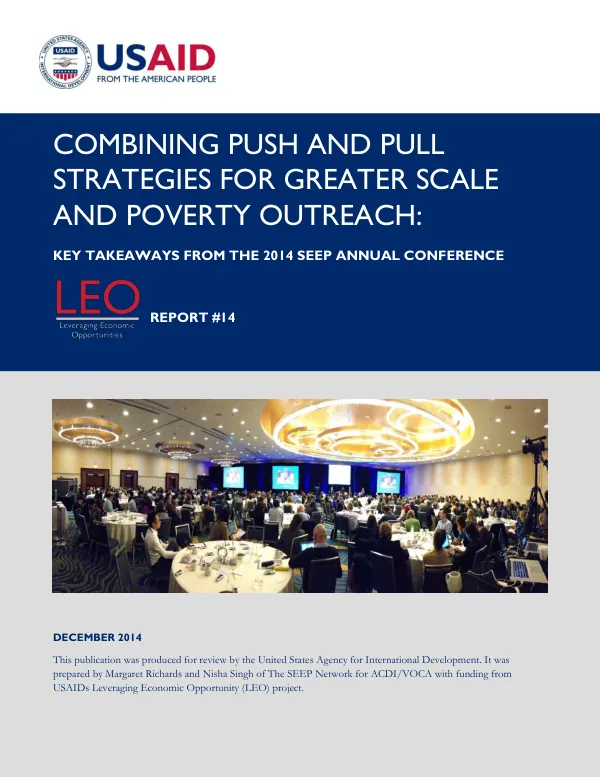
Combining Push and Pull Strategies for Greater Scale and Poverty Outreach was one of four learning tracks featured at the 2014 SEEP Network Annual Conference on Scaling Impact in Inclusive Market Systems.
2014 · 29 pages
Sign in to readA free account is required to download.
Abstract
Co-sponsored by USAID's Microenterprise and Private Enterprise Promotion (MPEP) and Food for Peace (FFP) offices, six peer learning sessions included practitioners and researchers from multiple organizations. This track highlighted field experience in applying elements of a push/pull approach to facilitate pathways out of poverty for very poor households through engagement in markets. In particular, all sessions were asked to address how push and pull strategies intersected—in both theory and practice—and how these strategies can work together to create more sustainable and scalable impact. A push/pull approach is a market-oriented, pathways-based approach to poverty reduction that utilizes both push strategies—which build capacities—and pull strategies—which facilitate access to economic opportunities—to incrementally drive more beneficial and sustained inclusion of the very poor into market systems. Many market development programs, such as those using a value chain development or Making Markets work for the Poor (M4P) approach, utilize 'pull strategies' to expand and diversify the economic opportunities available in a market system. However, the poorest of the poor often lack the appropriate resources, networks, or capacities to take advantage of these market opportunities. The market systems initiatives presented in the conference sessions integrated both push and pull strategies into their program design and implementation. Many of these programs did not start out with an intentional push/pull approach, but realized that typical market-oriented pull strategies were not adequate to integrate the very poor into market systems. Therefore, many of them adopted push strategies such as skills training, coaching, savings groups, and others. The following sessions were presented at the conference: Session 1, "Improving the Food Security of the Extremely Poor by Linking them to Markets," examined the challenges and approaches to integrating very vulnerable persons into input and output markets, as well as the roles of women and intra-household decision making. The session was presented by Dun Grover of ACDI/VOCA and focused on the Multi Year Assistance Programs (MYAPs) in Bangladesh, Burkina Faso, and Uganda. Session 2, "Push/Pull in Ethiopia: Lessons from Four Years of USAID Programming," examined push-pull initiatives in USAID Ethiopia, the roles of various actors, and highlighting key results and challenges. The session was presented by Anna Garloch of ACDI/VOCA and focused on the Leveraging Economic Opportunities (LEO) Project in Ethiopia. Session 3, "From Displacement to Empowerment: Market Facilitation for Reintegration in Uganda," presented models for three push/pull initiatives in Uganda, two in northern states with former IDPs, and one with national outreach using mobile phones. The session was presented by Brian Ssebunya of IRC and focused on the PEEP (Post-Conflict Recovery and Economic Empowerment of Returnees through Private Sector Development) program in Uganda. Session 4, "Entrepreneurs Wanted: Connecting Push/Pull Approaches," presented push/pull activities in three countries, including value chain strengthening in the Philippines and Tanzania and savings-led micro entrepreneurship in Tajikistan. The session was presented by Mike Bowles of the Aga Khan Foundation (AKF) and focused on the IRIS (Improving Rural Incomes through Savings-led Financial Services) program in Tajikistan. The push/pull approach is one way to bring together efforts of livelihoods development initiatives and market development programs to achieve poverty-reducing impact at scale. USAID's Leveraging Economic Opportunities (LEO) project is focused on addressing gaps in knowledge and practice that exist in the area of push/pull. The conference track was intended to bring forth program experience from a range of practitioners, to provide a forum for discussion on push/pull, and to offer learning for the wider development community.