USAID DEC
Learning the Names of Other Children through Songs and Games
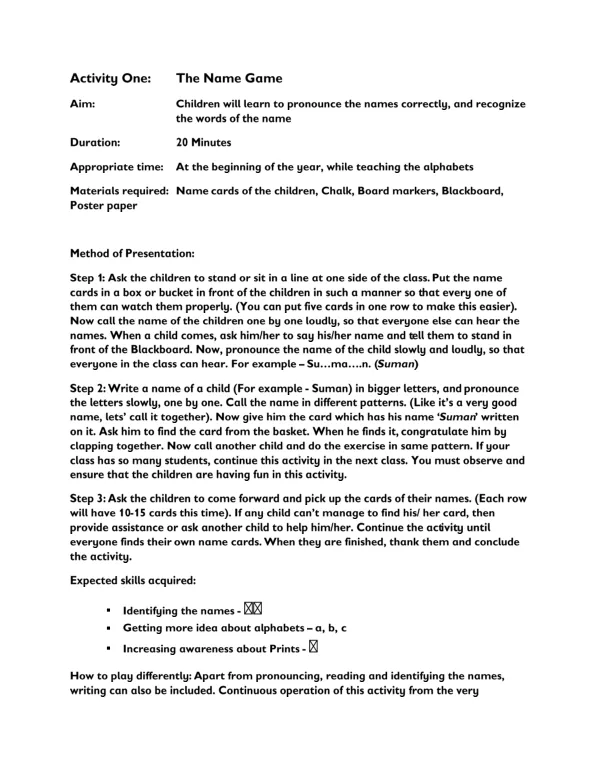
Learning the names of other children is an essential skill for young students, and it can be achieved through various engaging activities.
23 pages
Sign in to readA free account is required to download.
Abstract
One such activity is the "Learn Names through Songs" game, which aims to teach children the names of their peers by using cards and singing in groups. This activity is designed to last for 20 minutes and is most suitable for the beginning of the year when teaching alphabets. The game begins with the teacher distributing name cards to the children and sitting with them in a circle. The teacher then starts singing a song and passes a name card to the child sitting next to them, continuing to pass the card until the song stops. The child who receives the card last is asked to raise their hand, and the teacher reads out the name on the card, separating the letters for better understanding. This process is repeated, and by the end of the game, every child will have their own name card. Another activity, "The First Letter of My Name," focuses on teaching children to find the first letter of their names. The teacher distributes name cards to the children and asks them to find the first letter of their names, demonstrating the process with an example. The children are then asked to write down the first letter of their names in their notebooks, and if needed, the teacher provides assistance. To make the activity more engaging, the teacher can provide a portion of an old newspaper with large and clearly visible words, asking the children to find the first letter of their names from the newspaper. The "Musical Chair game with Name Cards" is another activity designed to teach children the letters of their names in an exciting and engaging way. The teacher stands with the children in a circle, distributes name cards, and starts singing a familiar song. Whenever the song stops, the teacher picks up a card with a random letter, and if that letter matches the first letter of a child's name, they raise their hand and sit in their place. This game can be made more challenging by asking the children to find the second or third letters of their names. In addition to these activities, other games such as "Short Name, Long Name," "Pairs of Word and Letters," and "Matching Game" can also be used to teach children the names of their peers and the concept of letters. These games are designed to be engaging and interactive, making learning a fun and enjoyable experience for the children. The "Short Name, Long Name" activity involves calling the children with long names and short names to stand in two separate lines. This activity can be made more engaging by making a list of names in a chronological order, from longest to shortest, and hanging it in the wall for the children to observe. The teacher can also show the difference in the number of letters or syllables in short and long names and the time it takes to pronounce them. The "Pairs of Word and Letters" activity involves learning to match letters and words with letters. This game can be played with other letters or even letters from other languages, making it a versatile and engaging activity for children. The "Matching Game" activity involves learning the words and letters of names, which can be played with easy words and numbers, making it a great activity for young students. Overall, these activities are designed to be engaging and interactive, making learning a fun and enjoyable experience for the children. By using these activities, teachers can help children develop essential skills such as learning the names of their peers, recognizing letters, and understanding the concept of words and letters.