LAND O'LAKES, INC. - INTERNATIONAL DEVELOPMENT
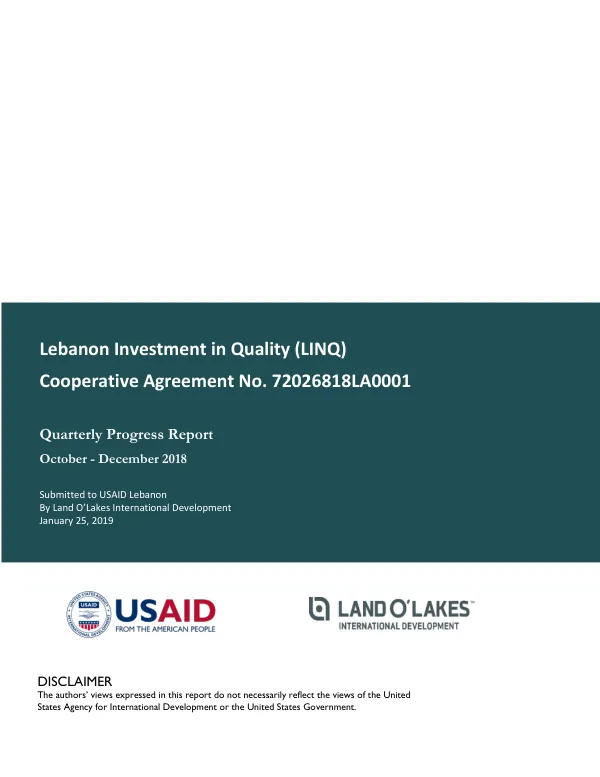
Lebanon Investment in Quality (LINQ) Quarterly Progress Report – Q4 2018
The Lebanon Investment in Quality (LINQ) program is a 39-month, $5,900,000 cooperative agreement awarded by the United States Agency for International Development (USAID) to Land O'Lakes International Development.
2018 · 9 pages
Sign in to readA free account is required to download.
Abstract
The program aims to increase the competitiveness of value-added agribusinesses in Lebanon through access to new markets, quality improvement, and product diversification. The LINQ program will provide technical assistance to value-added agribusinesses, their farmer and grower partners, and sound management of a $1.65 million grant fund. The project will also communicate learnings to stakeholders and work with actors along a supply chain with an entry point being agribusiness partners. The project will focus on improving production, foster investments that might not have been made otherwise, and establish linkages upstream to farmers and growers and downstream to destination markets. During the quarter from October to December 2018, start-up activities continued, and the team is now fully staffed with the identification of three additional positions. Key deliverables that will guide the rest of the project were completed, including the Sector Assessment, Grants Manual, and Monitoring, Evaluation, and Learning (MEL) Plan. The Sector Assessment was a key activity to provide the LINQ team with updated information on the status and potential future business opportunities in agriculture and food products in Lebanon. A multi-disciplinary team of four consultants was identified through a competitive selection process, but three consultants left the team, leaving the lead consultant to join forces with another consultant to complete the assessment. The report was reviewed by the LINQ team, amended as necessary, and shared with USAID on December 17th. The assessment prioritized selected sectors, including fruits, olives, and processed food products directly linked to fresh produce. Cross-cutting themes such as Food Safety and Quality, and Agricultural Practices will be given high priority and implemented with several partners. The LINQ team will consider looking further into the processed food sector with the possibility of engaging an external expert. The Request for Applications (RFA) was drafted to solicit business ideas from grantees within the prioritized sectors identified under the sector assessment. The first round of the RFA will be launched in January 2019 and advertised for in various forums. The LINQ team actively met with several stakeholders to gather information, learn about the agribusiness sectors, and what other projects, private sector organizations, and organizations are doing. The team also conducted Key Informant Interviews (KII) with 24 stakeholders to assess the needs, challenges, and opportunities that can be addressed by the LINQ program. The LINQ team is now fully staffed with four new positions, including a Grants Manager, a Communications and Outreach Manager, a Driver, and a Staff Manager. The team is prepared to begin field-based activities in the next quarter. The LINQ program will focus on improving the competitiveness of value-added agribusinesses in Lebanon through access to new markets, quality improvement, and product diversification. The program will provide technical assistance to value-added agribusinesses, their farmer and grower partners, and sound management of a $1.65 million grant fund. The project will also communicate learnings to stakeholders and work with actors along a supply chain with an entry point being agribusiness partners. The LINQ program will focus on improving production, foster investments that might not have been made otherwise, and establish linkages upstream to farmers and growers and downstream to destination markets. The project will also prioritize cross-cutting themes such as Food Safety and Quality, and Agricultural Practices, and will work with several partners to implement these themes. The LINQ team is now fully staffed and prepared to begin field-based activities in the next quarter. The team will continue to work with stakeholders to gather information, learn about the agribusiness sectors, and what other projects, private sector organizations, and organizations are doing. The team will also continue to conduct Key Informant Interviews (KII) with stakeholders to assess the needs, challenges, and opportunities that can be addressed by the LINQ program.