LAND O'LAKES, INC. - INTERNATIONAL DEVELOPMENT
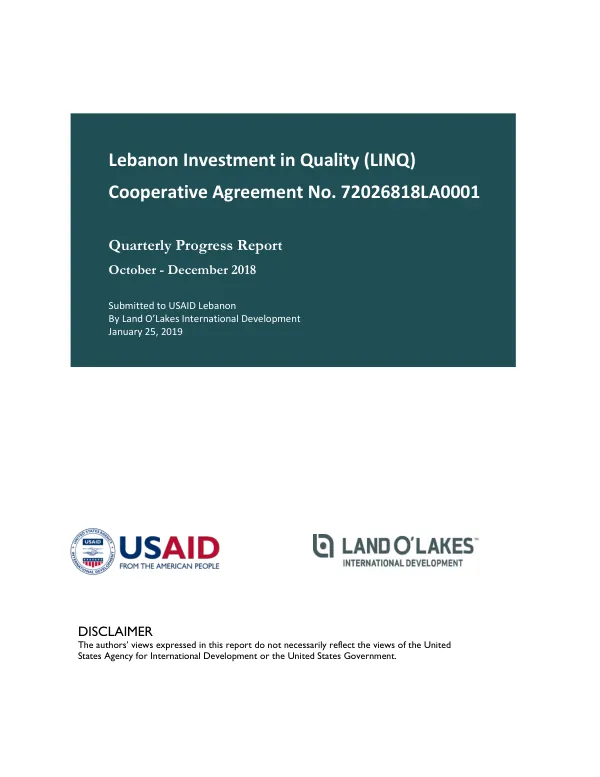
Lebanon Investment in Quality (LINQ) Quarterly Progress Report – Q4 2018
The Lebanon Investment in Quality (LINQ) program is a 39-month, $5,900,000 cooperative agreement funded by the United States Agency for International Development (USAID) to increase the competitiveness of value-added agribusinesses in Lebanon.
2018 · 9 pages
Sign in to readA free account is required to download.
Abstract
The program aims to provide critical technical assistance through consultants and volunteers to value-added agribusinesses and their farmer and grower partners, sound management of a $1.65 million grants fund, and communication and outreach of learnings to stakeholders. During the quarter from October to December 2018, start-up activities continued, and the team is now fully staffed with the identification of 3 additional positions. Several key deliverables were completed, including the Sector Assessment, Grants Manual, and the Monitoring, Evaluation and Learning (MEL) Plan. The Sector Assessment was a key activity that provided crucial and updated information on the status and potential future business opportunities in agriculture and food products in Lebanon. The assessment identified fruits, olives, and other processed food sectors as priority areas for the project. The LINQ team used a competitive selection process to identify a multi-disciplinary team of consultants to complete the sector assessment. However, three of the four consultants left the project, and the lead consultant joined forces with another consultant to complete the work. The resulting report was reviewed by the LINQ team, amended where necessary, and shared with USAID on December 17th. The main outcome of this assessment was the prioritizing of selected sectors, including fruits and olives, and cross-cutting interventions such as Food Safety and Quality, and Good Agricultural Practices. The Request for Applications (RFA) was drafted, and the first round will be launched in January 2019. The RFA will be used to solicit business ideas from potential grantees within the prioritized sectors identified under the sector assessment. The LINQ team actively met with several stakeholders to gather information, learn about the agri-business sectors, and what other donor-projects, private sector organizations, and others are doing in this area. The LINQ team is now fully staffed with the identification of 4 new staff, including a Grants Manager, Technical Manager, Communications and Outreach Manager, and Driver. The team is preparing for field-based activities to begin in the next quarter. The project will benefit supplying farmers and growers and their clients (packers, processors, buyers, and others) with a common objective of food quality, safety, and competitiveness. The project's focus is on increasing the competitiveness of value-added agribusinesses in Lebanon through access to new markets, productivity and quality improvement, and product innovation. The project will provide critical technical assistance through consultants and volunteers to value-added agribusinesses and their farmer and grower partners, sound management of a $1.65 million grants fund, and communication and outreach of learnings to stakeholders. The project's geographic focus is on Lebanon, and the project will work with actors along a supply chain with an "entry point" being agribusiness partners. The project will benefit supplying farmers and growers and their clients (packers, processors, buyers, and others) with a common objective of food quality, safety, and competitiveness. The project's timeframes are 39 months, and the project is funded by USAID with a budget of $5,900,000. The project's recommendations include the prioritization of selected sectors, including fruits and olives, and cross-cutting interventions such as Food Safety and Quality, and Good Agricultural Practices. The project will also consider looking further into the processed food sector with the possibility of engaging an external expert. The project will launch the first round of the Request for Applications (RFA) in January 2019 and advertise for it in newspapers and through forums.