USAID DEC
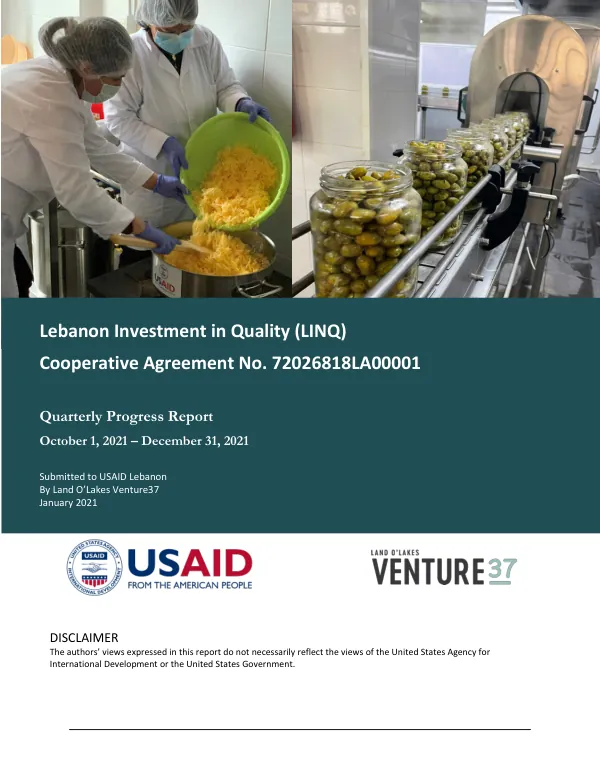
Lebanon Investment in Quality (LINQ) Quarterly Progress Report – Y4Q1, October 2021-December 2021
Sign inLAND O'LAKES VENTURE37
Lebanon Investment in Quality (LINQ) Quarterly Progress Report – Y4Q1, October 2021-December 2021
The Lebanon Investment in Quality (LINQ) activity is a 45-month cooperative agreement funded by USAID, with a total budget of $5,900,000.
2021 · 29 pages
Sign in to readA free account is required to download.
Abstract
The project aims to increase the competitiveness of value-added agribusinesses in Lebanon through access to new markets, productivity and quality improvement, and product innovation. LINQ provides critical technical assistance to value-added agribusinesses and their farmer and grower partners, sound management of a grants fund, and communication and outreach of learnings to stakeholders. The project is designed to work with actors along a supply chain, with agribusiness partners as the entry point. Through grant investments and technical assistance partnerships, LINQ helps partners improve their production, fosters investments that might not have been made otherwise, and builds linkages upstream to farmers and growers and downstream to destination markets. In addition to agribusiness partners, the project benefits supplying farmers and growers and their clients with a common objective of improving food quality, safety, and competitiveness. During the fourth year of implementation, LINQ continued to face serious economic and financial market disruptions and political instability in Lebanon. Despite these challenges, the project team managed to complete planned activities in a timely manner and initiated adaptive measures, such as moving to online platforms for most of the trainings. LINQ successfully completed and closed two grants, continued the implementation of nine active grants, and provided training and technical assistance to two businesses, one cooperative, and one association, reaching 168 individuals. The highlights from Year 4 Quarter 1 include the following results: the value of new private sector investment leveraged in Year 4 Quarter 1 is around $192,732, bringing LINQ overall results to 93% of the LOP target; overall, 168 new individuals benefited from LINQ activities, and 92 new farmers and individuals from organizations received training in year 4 quarter 1, bringing LINQ cumulative results to 160% and 143% respectively, higher than the LOP target; the overall proportion of females participating in LINQ activities related to increasing economic resources is 37% compared to a LOP target of 30%; and LINQ implemented four outreach and learning events and communication products. The technical assistance provision component of LINQ continued to support businesses to thrive by adapting planned activities to use telecommunication technology and providing remote technical assistance when possible. The purpose behind the demand-based TA partnerships is to support food processors and on-farm producers to acquire advanced skills needed to help improve their production process. This directly reflects on the quality of the end-product while also empowering young Lebanese and providing them with the opportunity to improve their agricultural knowledge. The training delivered this quarter covered many topics, including labeling and packaging design, and was provided to 168 individuals. The project's activities and results demonstrate its commitment to improving the competitiveness of value-added agribusinesses in Lebanon and increasing the quality and safety of food products. Despite the challenging context, LINQ has made significant progress in implementing its work plan and achieving its objectives.