USAID DEC
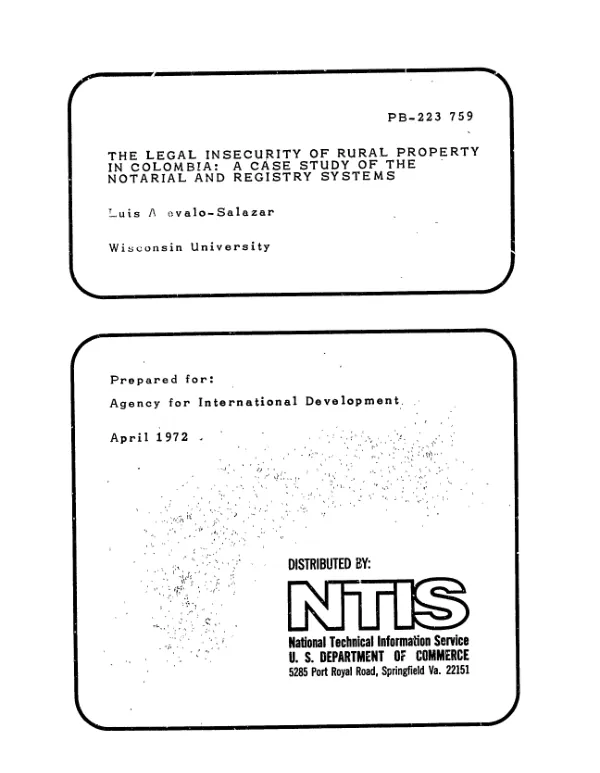
Legal insecurity of rural property in Colombia, a case study of the notarial and registry systems
Sign inUNIVERSITY OF WISCONSIN AT MADISON. LAND TENURE CENTER (LTC)
Legal insecurity of rural property in Colombia, a case study of the notarial and registry systems
A description and analysis of legal and administrative systems used in Colombia to title, transfer, and register agricultural land is coupled with an examination of a number of title registration and transfer cases.
Arevalo-Salazar, Luis · 1970
Sign in to readA free account is required to download.
Abstract
An effective system must minimize land title conflicts, perform administrative operations efficiently, provide property owners with reliable documents, and create adequate capacity and reliability in land record offices. In the Colombian system legal instruments for real estate transactions are drafted in notarial offices and recognized by law as legitimate, truthful, absolute, and credible instruments establishing public faith in contracts between specific persons. The system of land sale in Colombia is formal and complex, and many farmers fail to complete the necessary formalities, conducting real estate transfers without bothering with notary and registry procedures. Boundary identification and land measurement are very uncertain and lead to many legal tangles. Recommendations for modification include changes in the location of notarial and registry circuits, in the selection and qualification of officials, in the services offered, in inheritance and adverse possession procedures, and in the use of transfer taxes and private document transactions.
Connected topics